This review page is supported in part by the sponsors whose ad banners are displayed below |
 |
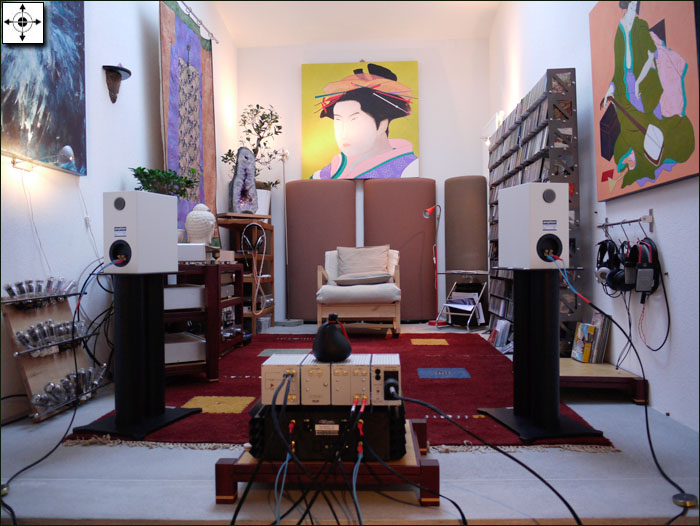
Perched on some Liedtke Design/WLM stands, the Heliums here were fronted by a Raysonic Audio CD228, Esoteric C-03 preamp set to 12dB of gain and a FirstWatt J2 stereo amp all leashed up with Franck Tchang's LiveLine cables.
|
 |
The verdict was quick and without any real surprise. While the Helium 510 had zero issues playing the desired/required levels and—surprisingly intact and recognizable—relocated from the nearfield to a more 'free-air' environment, the bass thinned out to impact overall tonal balance. Simultaneously, the higher SPLs required for the same at-the-ear levels of the previous nearfield scenario elicited more port contributions and hence, a looser more resonant gestalt in the low end. Because everything else was rather satisfying especially considering the sticker, I felt compelled to reach into my grab bag of cheap tricks for some friendly assistance. I pulled out WLM's four-module top electronic crossover.
|
|
|
Besides allowing active three-way drive with a number of relevant adjustments, it duplicates the firm's Diva Control. That's an inline bass compensator for WLM's passive Diva 10-inch two-way monitor. Placed between preamp and amp, the Diva Control is inactive above the third octave but hinges a variable analog bass lift (from 0 to +12dB at 25Hz) at 150Hz to delay a speaker's natural roll-off. There are obvious prerequisites. The driving amplifier must have enough headroom for higher compensation values. A given driver in its native loading must have sufficient excursion potential. The enclosure should not exhibit obvious resonance modes when exposed to higher low-frequency amplitudes. Whenever one first explores any given combination's happiness with compensatory equalization, easy thus does it with the hand on the control. After all, one wants to end up with truly enhanced rather than grotesquely imbalanced—or worse, outright distorted—performance. The idea is a subtle assist. It's not a quadruple D-cup bass implant.
|
 |
A mere 3dB boost netted unexpected gains, albeit of the slightly elephantine kind. Things got fatter but also more bloated because the inbuilt port boost was elevated too. It now was overdriven to contribute ringy resonance and overt boom. The perfect solution was at hand however. I simply stuffed the ports with the provided foam plugs. This altered the alignment to (semi) sealed. Voilà, this beautifully linearized the response. At civilized levels, a 3dB boost on the active network now was seamless and assisted the small Finn to reach 35Hz with sufficient output to play like a bigger speaker.
|
 |
Amphion of course need not advocate such cheating. They have a dedicated subwoofer for that role. But I had none nor a back wall to create a more typical listening environment for a small two-way monitor run solo. This experiment did however suggest that a room of the above size with a wall behind the amplifier—rather than thrice more open space—would support the Helium 510 to about 45 or 50Hz. By stuffing the ports, I had raised the speaker's built-in cut-off frequency while my 3dB boost stood in for the generic 3dB of so-called room gain. Without subwoofer, a medium room should work just fine.
|
|
|
Conclusion: Besides obvious monitor-type soundstaging, Amphion's entry-level model offers an unprecedented degree of upper midrange/treble refinement. This is decidedly not a function of pleasing colorations. Rather, it's due to an absence of subtle opaqueness which plagues equivalent speakers. The result is a higher level of intelligibility or insight—I think of it as informative or non-congested—that's not bought by addition at the expense of an uptilted HF response but via subtraction and elimination of common hindrances.
The Helium 510 is obviously downscaled in output potential, dynamic grandeur and bass weight and reach. That's intrinsic to its size and price. What's unexpected is the beyond-its-class fidelity, the ability to penetrate deeper into the musical fabric of the all-important midrange and mid/treble transition. A useful bonus of the controlled dispersion transition between its drivers is minimized beaming for broader sweet spot coverage.
|
|
Amphion's newest Helium 510 belongs to the essentially neutral school of loudspeaker design but is endowed with just enough textural elegance to avoid sounding dry and bereft on entry-level transistor gear. This small speaker clearly is blessed with design DNA that's about high natural resolution. It avoids most common shenanigans in this sector which would make a monitor appear meatier than it is to compromise ultimate clarity in trade for boosted upper bass. I simply wonder whether, a/ the average €900/pr speaker punter will recognize—and fully appreciate—just what this Amphion offers; and b/ whether more experienced audiophiles who would (or better put, should) recognize its advanced virtues still shop this sector. If I have any doubts about the Helium 510, it's not about its performance. Not one wit. It's about this positioning. But that's for the marketing folks and retailers to sort out and combat. Reviewers are free to focus on the sonics alone. Here the baby of the Finnish Amphion range proved to be rather more than expected. I'm now very curious indeed what this company does with its top-line three-way. Far more relevant however is today's small box - a big slice of the hifi pizza with most the toppings for a very fair price. Would Amphion ever consider a powered version of this model for instant plug 'n' play gratification? |
|
Quality of packing: Basic but effective.
Reusability of packing: A few times.
Condition of component received: Flawless.
Website comments: New 'what? why? how?' page has plugged a previous hole of cogently explaining the company's core credo.
Human interactions: Pleasant and timely.
Pricing: A very fair value.
Final comments & suggestions: Though it limits bass amplitude, nearfield listeners might enjoy the higher damping with the port plugs installed even if they don't face a wall. For subwoofer applications, this is nearly predictably the favored loading. This speaker's resolution and linearity exceed what's common in this price class to justify better electronics. While it's not been dialed so steeply as to mandate such electronics—the €220 Serbian Ampino integrated worked very well—lesser gear will leave more under the table than seems fair given the speaker's true potential.
|
|
|
 |