|
This review page is supported in part by the sponsor whose ad is displayed above
|
|||||||||
 |
|||||||||
 |
|||||||||
 |
|||||||||
Reviewer: Srajan Ebaen Source: Zanden Audio Model 2000P/5000S; Opera Audio Reference 2.2 Linear; Raysonic CD128 [on extended loan] Preamp/Integrated: ModWright SWL 9.0SE; Music First Audio Passive Magnetic; Bel Canto Design PRe3; Wyetech Labs Jade; Supratek Cabernet Dual [on loan from owner]; Melody HiFi I2A3 [on extended loan] EQ: Rane PEQ55 active merely below 40Hz Amp: 2 x Audiosector Patek SE; Yamamoto A-08S; FirstWatt F3 & F1; Bel Canto e.One S300; Eastern Electric M-520; Yamamoto HA-02 Headphones: AKG K-1000 w. hardwired Stefan AudioArt harness; audio-technica W-1000 Speakers: Zu Cable Definition Pro in custom lacquer; Anthony Gallo Acoustics Ref 3.1; Mark & Daniel Ruby with Omni Harmonizer Cables: Zanden Audio proprietary I²S cable, Zu Cable Varial, Gede, Libtech and Ibis; Stealth Audio Cable Indra, MetaCarbon & NanoFiber [on extended loan]; SilverFi interconnects; Crystal Cable Ultra complete wire loom [on extended loan]; double cryo'd Acrolink with Furutech UK plug between wall and transformer Stands: 1 x Grand Prix Audio Monaco Modular five-tier Powerline conditioning: 2 x Walker Audio Velocitor S fed from custom AudioSector 1.5KV Plitron step-down transformer with balanced power output option Sundry accessories: GPA Formula Carbon/Kevlar shelf for transport; GPA Apex footers underneath stand, DAC and amp; Walker Audio Extreme SST on all connections; Walker Audio Vivid CD cleaner; Walker Audio Reference HDLs; Furutech RD-2 CD demagnetizer Room size: 16' w x 21' d x 9' h in short-wall setup, with openly adjoining 15' x 35' living room Review Component Retail: 5,499/pr. |
|||||||||
 |
|||||||||
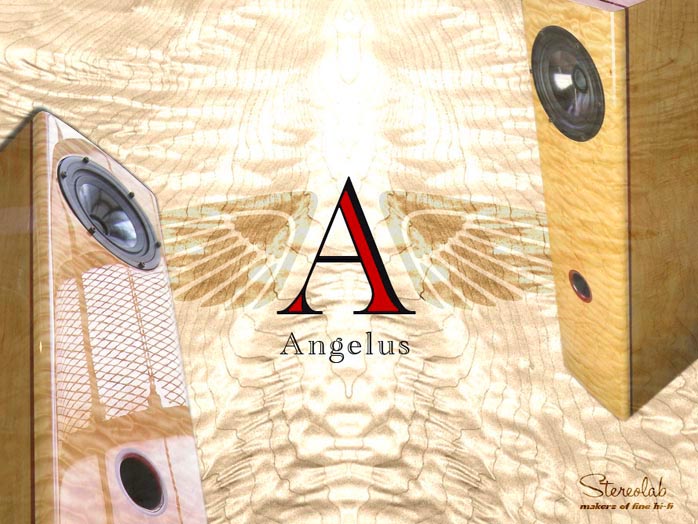
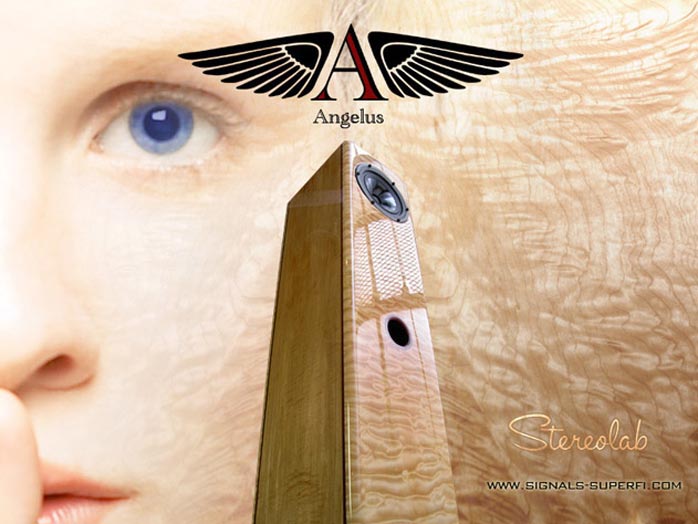
Stereolab Angelus. It's Chris Sommovigo's first self-owned entry into the madly contested loudspeaker market. His rap sheet, for a quick overview, began formally with Illuminati, the first true 75-ohm digital interconnect on the market. It landed him in the kourt of the Kimber king for a few years. Later, he hoisted his own flag at Stereovox, a company where he would further develop his own ideas on state-of-the-art cables. Without abandoning Stereovox -- quite the contrary, its product lineup is still expanding -- he then created Signals SuperFi as an import firm focused unapologetically on cost-no-object products from abroad. Think Continuum Audio Labs turntable from Oz, Peak Consult speakers from Denmark. He's now added the Stereolab brand to his roster. It makes the Angelus Sommovigo's first non-import speaker. Stereovox. Stereolab. The man's into 2-channel in a big way. The Angelus will become his second export brand crossing US borders from within if foreign markets embrace it. Cynics might quip that Chris was buttering his bread 10 ways from Sunday. Realists might question what kind of a work load he considers healthy. Sympathizers will understand that he's a terminal Hifi nut. He just can't help himself. He loves this stuff. And he has wanted a petite, high-performance loudspeaker finished in the finest of custom arch top guitar traditions. Quilted maple. Bloodwood stringers. The best lacquers. Point-source design. Front ported. When he couldn't find one to add to his Signals SuperFi stable, he did what every stubborn man with creative urges must. He did it himself. Well, kinda. We'll get to that momentarily. It's no farmed-out Sino cabinet production neither. This speaker is built north of the border in Canada. Dipped into gawd-knows how many coats of lacquer buffed to the max, it's a "Franco Serblin wet dream" according to Chris who's made quite the name for picking winners when you consider Stereophile's Product of the Year 2006 for the Continuum Labs Caliburn and similar accolades for Per Kristoffersen's Danish speakers. Add Stereovox and the evidence suggests a man of refined tastes -- cue Oscar Wilde's "My tastes are simple - I want the best" -- who isn't afraid to reach deeply into his own wallet. Or yours. That's the first order of Angelus business to settle. At $5,500/pr for a 7" 2-way measuring all of 34" tall with a 9" x 12" footprint, it'll take buyers of sophistication and desirous of upscale cosmetics to fully appreciate this compact creation with the single driver. Truth be told, the smaller rooms many melomanes call listening sanctuaries often don't justify anything beyond the driver artillery of the Angelus. Many upscale shoppers buy too much speaker for the room. They might have bagged the trophy creds but also settled for compromised sonics by overloading their space or not getting driver coherence because they must sit too close. The Angelus promises major trophy vibes without overpowering a room acoustically or size wise. And its dual-concentric transducer licks the listener distance limitation of big multi-ways and enjoys many precedents with Tannoy, KEF, Cabasse, Thiel and TAD to name but a few. It places the tweeter in the throat of the mid/woofer where you'd conventionally expect the dust cover or phase plug. It's the point-sourciest way to get full-range performance from what looks like a single driver. Unless you go Cabasse and dream up exotic tri- or quad-concentric wonders. |
|||||||||
 |
|||||||||
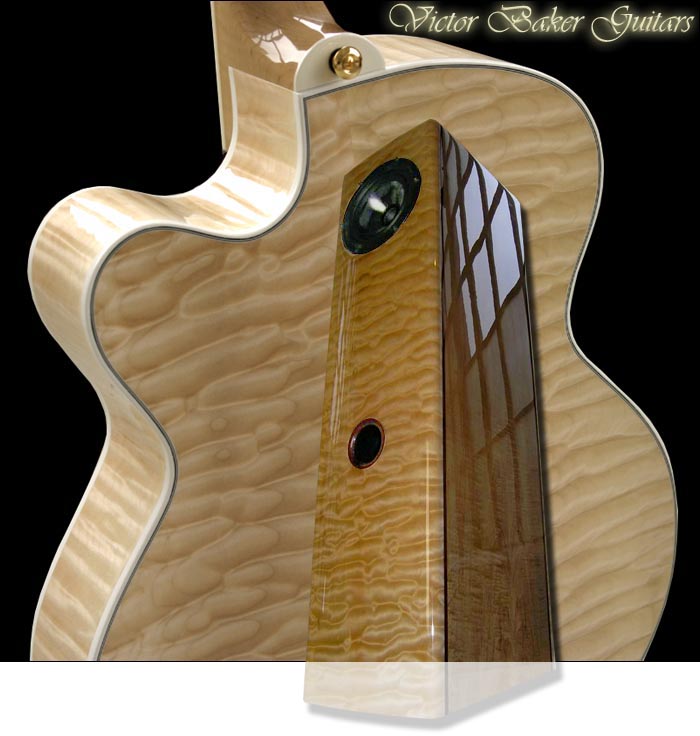
Good two-way towers are the smartest HiFi choice for real-world listeners in many ways. Mini monitors on their stands take up exactly the same floor space but destroy visual continuity and sacrifice cabinet volume to likely do less bass than a speaker that chucked the clunky metal stand and simply extended the monitor's walls to the floor. My favorite high-performance affordable 2-way floorstander is Klaus Bunge's Odyssey Lorelei. On the farther end of that scale sits Bobby Palkovich's celebrated Merlin tower fully gussied up with BAM module. Far beyond the Merlins lie the mythic lands of the Kharmas and their playmates. And every step along the way, there's plenty of choices to drive yourself nuts over. Looking at the grand scenery, the Angelus is mid-priced at best. Viewed from a realistic perspective that is less concerned over ultimate finish than raw parts, it's expensive. Before you're so sure about realistic though, let's back up. "Stereolab came into being as a result of making new acquaintances through old ones. A friend responsible for introducing me (and who knows how many more) to the magic of David Berning amplifiers -- I own his old Siegfried and you'll have to pry it from my cold dead hands -- told me about speakers a friend of his made. Based on a design that I was sent to listen to, I rendered feedback. The conversation evolved such that we decided to create an in-house brand for Signals -- Stereolab -- to become the global epicenter for the advanced design plus similar efforts in the future. "I fed back desires about changing/shaping the sound and also delivered the design brief for the cabinet - it started life as a much taller triangular enclosure. The evolved Angelus is based on a Seas coaxial driver. Any future designs will also be based on point-source drivers, possibly augmented by a woofer to go full range. The Stereolab speaker theme is true point-source dispersion along with extreme finishing. The front and rear baffles are ever so slightly curved from left to right, accomplished by CNC machining. The veneers are all top grade. The finish is deeply and luxuriously polished. Internally, the cabinet contains a special sub enclosure and a few tricks we like to keep under wraps for now. |
|||||||||
 |
|||||||||
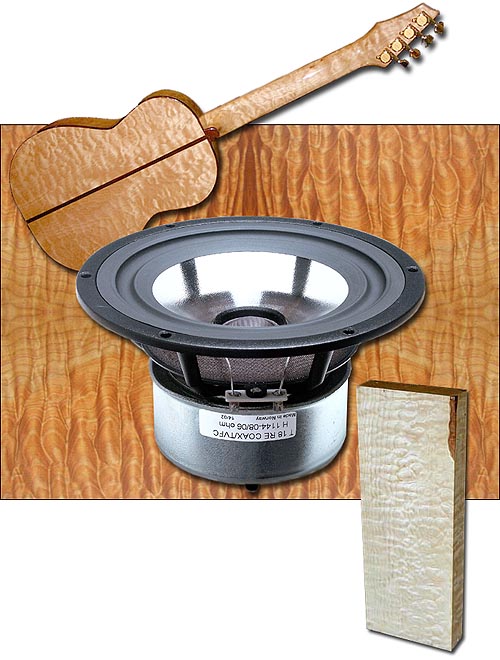
| "The challenge has been whether can we deliver world-class performance in a loudspeaker manufactured in North America, with people being paid fair wages, finished to compete with $20 to $30K loudspeakers and deliver the product for well under $10,000/pair. On the surface, it seems like a strange challenge. Who couldn't do that? But when you start using premium parts, build to fine furniture standards and pay people what they're worth, things get very expensive very quickly. I considered a direct-market scheme to drive the price down but I have always felt that dealers are critical to long term success. The value good dealers bring to the table is impossible to deliver remotely." The operative term here is fair wages. As long as the Yuan remains deliberately devalued, the notion of fair wages in China doesn't meet Western standards. Slave labor and sweat shops are common perceptions. Fair wages in the West for impeccable work by skilled craftsmen on the other hand aren't a subject commentators shopping the Internet for discounts while arguing speaker pricing will take up if they have half a brain. Alas, this isn't an economics paper. Unbelievers will call the Angelus too costly and move on while we get right back to it and think of it as a luxury product that looks every bit the part. Its quoted F3 is 35Hz, exactly what you'd expect from a quality 7-incher loaded into a box of friendly dimensions - perfect for a 13' x 18' room or smaller. Even the port ring is trimmed in Bloodwood to complement the two stringers that bisect the cabinet from top to bottom as two thin slices showing on the sides and across the top. No grill, naturally. Who has ever heard of an arch top guitar with a grill? Single wire terminals are just as obvious. Who in their right mind would dedicate an amp just to drive a tweeter? Sensitivity is a run-of-the-mill 88dB, perhaps just shy of your average SET-ish amp, perhaps not. It'll be something to test with the 18wpc Melody HiFi I2A3. |
|||||||||
 |
What else was Chris' designer willing to divulge about the network, innards and construction details of this superfly of the SuperFi ring? Regardless of specs and interior fabrication tricks, the Angelus will rise or fall based on cosmetic wow factor. It's gotta be a Halle Berry stunner. It'll also have to sound accordingly. For the moment, we'll assume that's been handled. The gotta-have-it allure to elevate the Angelus from all the other choices in this sector will largely depend on seeing it. If it is truly angelic up close & personal, photos won't do it justice. Confirmation on whether it'll measure up on the Jinx scale will have to wait until a pair lands in Cyprus. |
||||||||
| On paper, the Angelus concept makes perfect sense. To me. My mantra is that you look at your hifi more than you ever get to listen to it - if it's in the living room where it belongs for the whole family to enjoy rather than locked away in a basement dungeon. Shouldn't you cherish what you're looking at instead of making excuses, no matter how rational or subtle? If you answer yes and are savvy enough to know that a premium 7-inch woofer can make all the bass your | |||||||||
| smallish space may support before turning into mud city, the Angelus -- small but oh-la-la -- could be the ticket. That's the selling proposition. We'll see on the buying proposition in due course. For now, here's what else I learned about Chris' evolution from Illuminati to Angelus. The cabinet maker for the Angelus project is Jim McCleave, son of one of Canada's most famous luthiers and violin makers. The running subtext here of musical instruments -- arch top guitars in particular -- isn't puffery (and for realistic pricing, consider the Bendetto guitar brand which can easily - um, deposit you on the far side of $20K). Added Chris whose wife was a violinist with the Atlanta Ballet Orchestra before the latter cancelled the musicians' contract to run canned music with its performances, "with guitars, you are paying less for the material and more for the skill level of the luthier. Tonewoods for good guitar tops are typically not exciting and aren't very expensive - spruce, cedar, redwood, pine. When hardwoods are used because they look better, they typically sound forward in the midrange. It's the sides and backs that wind up being hardwoods." Angelus is MDF with hardwood skins - on all six sides, no strings attached. "The enclosure adheres to the golden ratio with added eccentricity. The two-part internals allow for superior bass accuracy. The sides and fronts are made from 1" thick MDF with varying thicknesses (i.e. 4" thick on the bottom, 2" thick in the lower section etc). The enclosure is saturated externally with epoxy, then veneered by vacuum bag, then coated with epoxy. Various damping adhesives are used in construction to cancel vibrations. They are hand-assembled, including exotic solid woods for trim. They are then hand-sprayed with multiple coats of fine Italian Polyurethane lacquer, with sanding in between. The final coat is hand-sanded with 1500 grit paper, then 2000 grit, then 3000 grit. Then the whole thing is hand-buffed to a mirror finish. "The crossover addresses problems that coaxials have in general and certain characteristics this coaxial has in particular." Production is slated for early spring, with interest in particular finishes gauged at CES 2007' passive Signals SuperFi Angelus display. The first five pairs built include one pair in quilted maple and four in book-matched tiger maple, the latter from natural blonde to various stains. When you consider the stable that Angelus will be parked in, right across from the Caliburn and new Criterion turntables and adjacent to the Peak Consults; when you consider that Chris has aimed high with SuperFi and not tarnished its profile yet; you'll have to assume that Angelus for all its designer luthier charms is more than just a pretty face or toned centerfold body. Otherwise Chris has let infatuation blind him to put his name on the first dud under the Signals umbrella. Which is possible. But I somehow find that a bit hard to imagine. Even so, the chips will fall where they will, regardless of bling, propaganda and a distributor's overt enthusiasm that signals fi across the Atlantic to the very ends of the Mediterranean in remote Coral Bay. |
|||||||||
 |
On the subject of enthusiasm and genetic influences, Chris shared the following in a subsequent e-mail: "I mentioned on a couple of occasions Sonus Faber and Franco. That's because the company when it was under his control made some of my favorite speakers of all time and I thought of Franco Serblin very highly. Over the years I've owned two pairs of Electa Amators (which I still think are his best design), a pair of Extremas and a pair of Guarneri Homage. Just for reference, I went to look up the old reviews on Stereophile's site to see how the limited range performance of these speakers compared to their prices (fairly pricey in their time). The Electa Amator had a published response of 42-20kHz at 88dB and with stands sold for $5,450. Adjusted for inflation, that would be close to $8,000/pr today. "Extrema had a published response of 35-18kHz at 88dB and with stands sold for $14,000pr - over $20,000 in 2006 dollars. 1992's Loudspeaker of the Year. Mighty tall cotton. The Guarneri Homage is yet another fine example. 55-20Khz at 86.5dB selling for $9,000 in 1994, which brings us near its present selling price of $13,000. Regardless of what one may have thought of the performance of these speakers at the time or what one may think of them now, there can be no doubt that they were built and finished beautifully and commanded a price commensurate with their build quality." |
||||||||
| Now the Angelus clicked. Big time. As a dyed-in-the-walnut Sonus Faber owner, Chris wanted his own slice of Signore Serblin magic. He went on to rap about the perceptional shift the ongoing influx of more and more upscale looking affordable Chinese products has had on Western notions of value. Meanwhile well-to-do Chinese audiophiles look west for satisfaction. No made-in-China labels for them. The implied message? It's the East that would instantly grok the Angelus and view it as a true value while the Walmart mentality of the West could be impervious to its charms. Material for a doctoral thesis perhaps. The Sonus Faber detour now defines Angelus. Serblin's theme of pebbled leather on walnut staves simply becomes arch top guitars. With its identity and target audience locked firmly in place -- perhaps even predicting sonics after what Chris shared on his speaker tastes? -- what else could he throw into the Angelus mix to round out its unique selling proposition? "When I first heard the predecessor to the Angelus, I had a similar feeling to the one I had when I first listened to the Electa Amator so many years ago. While these ears are no longer as fresh as they were back in 1988, they're also not as naive. Angelus and Electa Amator don't share much in the way of sonic flavor. Rather, Angelus presented me with a broadcast of sound that was remarkable, affecting me in the same way that the Amator did almost 20 years ago. What I heard excited me in the same way that the Amator did but for different reasons. In the prototype of the Angelus, what I heard was beautiful potential. I heard something 90% or 95% of the way, needing just the last little bit of refinement - and I wanted to somehow help get it the rest of the way. |
|||||||||
 |
|||||||||
"Each audiophile has at least one sonic fetish. For me that fetish is soundstaging and imaging. When a pair of speakers is able to completely disappear into the sonic landscape and lay bare the beauty of the music being pumped through them, I am that much closer to the artist and that much further into the music. And in order to get that beautiful, hologrammophonic presentation, so many things need to be right - the drivers and crossovers have to be well-matched; the wave interference between drivers must be minimized; the balance of frequencies needs to be neutral; phase error must be low; and the cabinet must be adequately inert. "At the highest end, I believe that Peak Consult does this with unmatched aplomb, tremendous musicality and an organic presentation. In the more competitive $4K - $6K range, I think the Angelus package of attributes is peerless. That's my personal buying proposition - the things I want to play with, be involved with. They must excite me and make me think that they are peerless in their category. Continuum blew my mind with their extreme advance of the vinyl reproduction art. Nothing I know or ever knew has come close. Peak Consult was a realization that evolved my sense of "reference" and refined and confirmed my feelings about beauty. Stereovox has been my personal quest for excellence and elegance through simplicity. Angelus is another awakening, to the possibilities of real high performance for a reasonable investment. "Notice I didn't say price. Price is something you pay for a consumable like pizza or gasoline. Price is something vacuous that gives back less than it receives. Investment implies value. Something invested in gives back in excess of its initial cost. And while I consider all of my lines investments, it's much easier to more broadly identify the value proposition in a sub-$6K loudspeaker than in a $100,000 turntable. "In 1988, after seeing, touching and hearing the Electa Amator, I deeply understood the value of that $5,500/pr mini monitor. I was in college and wouldn't be able to afford to play at that level for quite some time afterward but its value was clear to me. With Angelus, we're going to be able to offer a beautifully made, floorstanding high-performance loudspeaker handcrafted in North America, in 2007, for that very same price. That's exciting stuff." |
|||||||||
 |
|||||||||
 |
|||||||||