 |
|||||||||||||
 |
|||||||||||||
 |
|||||||||||||
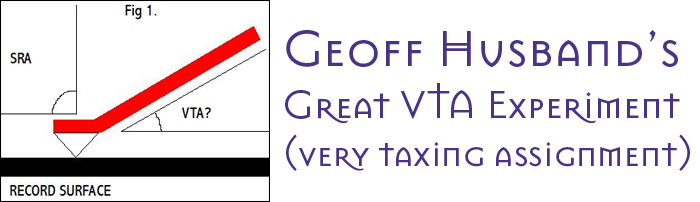
The Great VTA Experiment Geoff Husband has asked us to post his VTA experiment call-to-action on 6moons and we are delighted to do so. Geoff is a senior reviewer on www.tnt-audio.com, and one of the most respected figures currently writing on vinyl. In fact, his series of turntable reviews are models of their kind and I would urge anyone with an interest in analog to study them. The experiment Geoff invites us to is self-explanatory. Hopefully there will be enough heroic volunteers to make the samples representative. As Geoff has explained, the experiment is being conducted in the spirit of scientific enquiry rather than trying to prove one camp or the other right. It will certainly be fascinating to see what a representative sample of actual users comes up with. Above all, I want to reiterate that Geoff's experiment has nothing to do with the so-called 'quality of our hearing' or golden-ear competitiveness. His associated article on VTA is essential reading for anyone serious about vinyl playback. Of course every audiophile -- from seasoned manufacturer right across to those who have just caught the bug -- knows intimately about the issues of trying to distinguish between what we perceive as real and objective differences in sound quality on the one hand, and psycho-acoustic ones on the other. We substitute cones, change plugs and listen for changes. At these minute levels, it is very difficult to distinguish between what's really going on and often the effort involved means we might want to hear changes – and so we do. I believe that these psycho-acoustic effects are not only real in the sense that our brains are responding to our wills (in the same way that people's health can be affected by placebos), but that they also affect all our component and system changes. After all, the more money we throw at a problem, the more we want to hear the effect. This self-fulfilling will power has a big effect on how we perceive the results. Vinyl has a reputation of being something of a black art. One thing I'd like to say about that is that it would be a real pity if it put off audiophiles who are thinking of putting a foot into these wonderful waters. Some experts warn people off by claiming that you need huge experience to get a vinyl system to sound good. I both agree and disagree (how about that). It's true that to get the best results, you do need to sweat the details but I'm always surprised by how far I can get things wrong and the record will still track and play wonderful music. Many people return from a junk sale with an old turntable in tow and are amazed by how good it sounds. And once you have one, the learning curve is really pretty fast. So please - don't be scared off by running battles between people driven by their passions. |
|||||||||||||
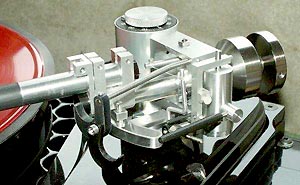
| My own position on the subject? When I made some small changes to SRA on an arm a few years ago, I thought I could hear them- but I now believe that this was a psycho-acoustic phenomenon. This is primarily because -- as I mentioned to Geoff when he was writing the article -- I'm still very much surprised by the extent to which my turntables are able to track severely warped records without any audible protests. I've got a Van Morrison record that to a needle must look like the Grand Canyon. The warp is more of a dent, with wall slopes of more than 45 degrees interjected with a flat bit. Even with a Clearaudio Clever Clamp under a record weight, the dent must be 3 or 4mm deep and about an inch long. When a cartridge is set up well, no one I've had around for a listen has ever heard the warp. Think about that, This | |||||||||||||
 |
|||||||||||||
| warped condition is equivalent to a change in arm height /VTA/SRA dozens if not hundreds of times larger than the minute fractions we are routinely discussing in disputes about what kind of VTA/SRA changes are really audible – and this warp causes this altered condition at great speed every two seconds. Go figure. Worse, there is no question that this dent has a significant effect on the tracking force seen by the cartridge. While both of these crucial parameters are changing, I sail blindly through them and completely unaware of the ongoing miniature earthquakes on my record. Thank goodness for that. I'm pretty sensitive to repeated extraneous sounds on vinyl. Frankly, if I could hear warps, I'd junk records as too big a trade-off compared to the convenience of CD. So I guess that means I haven't got a micro-metrically adjustable VTA tower arm on the top of my wish list? In fact, that's a feature that would count against the arm as adding unnecessary complexity. To me, vibrations are the biggest bane we suffer in turntable life. A good wall shelf is a significantly greater priority to the final sound than being able to repeat small changes in VTA and adjust the arm for each record in my collection. |
|||||||||||||
So without further ado, here is Geoff Husband's |
 |
||||||||||||
| The Great VTA experiment or "Knowing Me Knowing You - AHA" (apologies to ABBA...). Phew! Well, I thought my VTA article would be controversial but I underestimated just how upset some people would get at me for merely 'thinking aloud' about the problem. And yes, it is a problem. We have a controversy where people hold to deeply entrenched views. In one corner, we have Roy Gandy, designer of the most popular and influential tonearm of the last 50 years who thinks the whole VTA thing is rubbish. In the other corner, we have Roy Gregory of HiFi+ who thinks that with some records, changes in arm height of 0.018mm produce "vital" changes in sound. These are both credible figures. They both have armies of supporters in the industry and amongst informed listeners. They both can't be right and just to float around in some compromised 'middle ground' is a cop-out. The single biggest problem is that most of the argument on 'VTA' towers and the like is based around personal impressions or laughable experiments that would end up in the bin if submitted to any scientific journal. It's my aim to get as many people as possible to undertake the following experiments so we can at least have something with vaguely scientific credibility to argue over. Please spread the word far and wide and get as many people as possible to take part and pool their results. An apology is in order. In a previous life, I was a science teacher. If I sound pompous, hectoring, patronizing and smug during the following, forgive me because it comes with the territory. Think yourself lucky that you are out of range of the board rubber... "pay attention, class!" What makes a good experiment? Let's look at a bad one. Magazines tend to avoid 'blind tests' because they take a lot of time and may throw up results uncomfortable to them. But they do produce tests which masquerade as 'blind'. We've all seen them. The favourite subject is cables because they are easy to swap around and also leave plenty of 'fudge' room afterwards. In a typical example, a 'tester' invites a few pals to his house. Over a cup of tea, he (sorry - it's always 'he') plays some music. Every so often, he goes up to the system, everyone closes their eyes and he swaps speaker cables. They all listen some more. If it's a good test, they don't talk to each other and make notes - but usually, they chat. Then the tester goes off and whilst everyone closes their eyes, he changes the cables again. Great - a perfect scientific blind test. Not. The whole test is utterly worthless. The single biggest flaw is the 'human factor'. The Human Factor We have evolved over millions of years to become the most socially sophisticated animal on the planet. We talk, we gesture, we interact. This is all conscious but we also do a mass of unconscious things. Man is, for example, the only animal to lie in a sophisticated way. We can spot lying. Sometimes we don't even know we do it. When we lie, we send out a whole series of subtle clues, most of them 'displacement activities' of some form or another, which others can spot. But more important are the unconscious abilities we have that help us maintain a group bond. That group of friends on the couch listening to cables will not know the cables being tested, but they will be on their guard looking for clues to stop them looking a fool. The tester will no doubt already have opinions on the cables in question. His body language or speech will be different for a cable he likes to one he dislikes. I'm not talking about a parody like "now guys, listen to this one!", but subtle unconscious clues that the panel will instinctively pick up. If the tester tries to insert a control by not changing the cable (though strangely this basic requirement of such a test is rare), the tester will radiate 'lying' clues. |
|||||||||||||
The group will also want to conform. Given a tricky question like "can you hear this?", the group will look for clues and try to intuit the position of others - are they making 'positive' of 'negative' moves? In the end, such poorly run experiments often end up with wonderfully conclusive results where everyone agrees with each other. And because they carry the blind moniker, such tests gain completely unjustified credibility. |
|||||||||||||
 |
|||||||||||||
| You doubt the influence of these factors? Some people are specialists in consciously reading these signs. We call them magicians or fakirs, mind-readers, mediums or gurus. A true story. Last week, a friend of mine went to a wedding anniversary party. They had a magician. He specialized in close-up magic, card tricks, slight-of-hand etc. The last thing he did was to go around the table with a pack of cards - imaginary cards. He went to each guest and said "pick a card, any card" and held out his imaginary pack of cards all fanned out. The bemused guest pulled out an imaginary card and he said "Don't show me, now look at the card and remember it, now put it back in the pack". The guest put the card back in the pack and he said "do you remember the card? Sure, it was the four of clubs!" The astonished guest admitted he was right. He then went around the table and did the same with every guest. By the 12th and last person, people were really on their guard but still he got it right. It was a stunning demonstration of the power of suggestion and reading people's unconscious signals. Compared to that, figuring out whether the guy next to you likes the cable he's listening to or not or what the tester thinks is a doddle even for the layman! So any experiment must rigorously exclude any possibility of the human factor. And that is why the experiments below set such strict instructions on how they must be conducted. The Experiments The first thing I should say before we begin is that to prove a theory is impossible. Here we have a mere hypothesis, namely that changing arm height has a critical effect on sound quality. The following experiments may disprove the hypothesis but will not be able to conclusively prove it is correct. They may be able to put up very powerful evidence for it but not more. All scientists are devil's advocates and will look for the tiniest chink in the armor of any theory. So after that rather long preamble, here are the two experiments. You'll see that I have not used the abbreviations VTA or SRA because I am not convinced that either is the critical factor that we are changing. We may be optimizing something, but to use one of those terms prejudges the result. The only thing that I am prepared to accept is that we are altering arm height so the pedant in me forces me to use the abbreviation AHA (Arm Height Adjustment). For these experiments, you will need one or more flat records. I don't mean flat but flat! It's pointless undertaking an experiment on AHA when the basic material has a run out of +/- 0.1mm. Finding a perfect record may be the most difficult single task you have to perform. As the test progresses, --especially if several subjects are tested - you may need more than one disc to avoid playing a track more than 50 times and damaging it. Sorry, but you'll also need an arm with micrometer height adjustment. I know that excludes many of you but you could surely find a dealer prepared to put this to the test. Organize a group of friends to go - make the effort! And on the question of effort, I accept that the tests are going to be time-consuming and not particularly riveting to undertake but some of you may be tempted to spend thousands of pounds on an arm you don't need - or alternatively, you may find you would really benefit from such a purchase. Don't you want to know if it's worth it? Experiment One - An attempt to find the critical limits of AHA in your system and for your ears Equipment for this experiment: a blindfold, a stopwatch and a prepped results sheet. Before the test, the subject should set AHA to what they consider the best possible position for the disc in question. This will become the baseline position for the experiment. The subject should be seated in the best position relative to the system. The operator and turntable must be totally invisible and generate no noise whatsoever during the duration of the test (if you cough, you have to repeat that set of tests). The operator might hide behind a screen or the subject could wear a blindfold - after all, the subject only has to make ten marks on a piece of paper. No one else can be in the room and the operator must not move any more than is absolutely necessary to operate the turntable. If any of these rules are broken, the experiment is invalid. The operator will play a section of a track of an album chosen by agreement with the subject for ten times. On five occasions, the AHA will not be changed but the adjuster will be turned and returned to the baseline position during the intervals between music. On the other five occasions, the AHA adjuster will be altered to raise the AHA 1.0mm. The order of play should be random and the operator needs to write down the order prior to the test and adhere to it. The order should be one of the following, used at random, with 'A' being change, 'B' no change: A,B,B,A,B,A,A,B,A. or B,A,B,A,B,B,A,B,A,A. or B,B,A,B,A,B,A,B,A,A,B. or A,A,B,A,B,B,A,A,B,B. It's easiest if you use squared paper and leave spaces for the subjects results next to the operator's plan. This will aid later analysis. |
|||||||||||||
| The operator needs to practice the procedure before the experiment so that he/she can play a 30 second section, then alter the AHA in the next 30 seconds and recue the same section of the record once again. The subject will hear 30 seconds of music, 30 seconds of silence, 30 seconds of the same music and so on. After each section, the subject writes down 'A' if they think they hear a change, 'B' if they think they hear no change. At the end of the ten plays, you can stop and compare notes if you wish (just make sure the subject doesn't see the operator's notes for the next test!). Now repeat, only this time the operator lowers the AHA 1.0mm for five of the ten excerpts, with the other five being no change. |
|||||||||||||
 |
|||||||||||||
You now have results that show the subject's ability to distinguish AHA variation plus/minus 1.0mm. If the results show that the subject cannot reliably identify changes i.e. they make one or more errors, then repeat the experiment with identical settings just to make sure. If there are still mistakes, the subject cannot reliably distinguish AHA variations of +/-1.0mm. The next test should be for +/-1.2mm Keep repeating the experiment until the subject gets a straight 10/10 score for two consecutive test. You need to repeat things like this because one might get 10/10 by chance just like you can throw three sixes in a row at times. Assuming the subject gets a straight 10/10, you then repeat the experiment with the up/down change in AHA being 0.8mm. Then progress to 0.6mm and so on right down to the resolution limit of your arm's AHA adjuster. When the subject reaches their limit of resolution, go up one and repeat the previous test to make sure the 10/10 they got with that test was not due to chance. Interpreting the results What this test should show is the limits for critical AHA adjustment for a given combination of subject and system. If you find that the resolution is, say +/-0.6mm, you know that you are safe in setting a single AHA which will cover the thickness of most records. Congratulations, you can go back to fiddling with your records and not with the arm. It would also be pointless to then continue with experiment #2. There is of course one gaping flaw in this experiment. It doesn't cover the problem that the subject may be hearing alterations of the arm mechanism as described in the accompanying article. I've tried to cover this to a small extent by making the operator move the adjuster even when the AHA is not to be moved - but the possibility still remains. If this is the case though, I would expect the results to look rather scattered and independent of the distance the AHA is altered. But mechanical change is a possible explanation for a set of given results. The second flaw is that this experiment only measures whether we can hear change, not whether this change is significant or musically important and sounds better! That is the purpose of the second experiment. Experiment Two - To find how accurately the subject can identify the AHA position which gives the most musical result If the subject has already failed to distinguish small AHA changes in experiment #1, then this test is pointless and you can all have a drink and go back to listening to music. |
|||||||||||||
| The subject chooses a favorite record that they are happy is sensitive to AHA change. It must be very familiar to the point of possible boredom. The subject now can spend as much time as they want to get AHA perfect for that record. This will be the first recorded AHA position. Once again the operator must be out of sight, silent and unmoving. The subject must be blind. |
|||||||||||||
 |
|||||||||||||
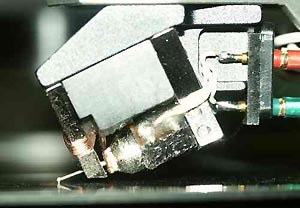
| Regaining the preferred seating position, the operator will move the AHA adjuster away from the preferred position either up or down, sometimes a long way, sometimes not so far. The subject then calls out 'up' or 'down' to the operator who acts as a kind of remote control i.e. efficient and silent. When the subject is perfectly happy, | |||||||||||||
| the operator notes the position after the subject has cried 'perfect', randomizes the adjuster and repeats the experiment. There is no limit to how often you can do this and how many records you chose, but you should plan on a minimum of 10 tests. Interpreting the results Now you should have scattered results, which will show to what accuracy the subject can pick 'perfect' AHA, from a musical point of view and with a variety of records. The flaws? The subject could still be zeroing in on sweet spots in the arm mechanism but if you use records of different thickness, this would mean that you would be passing through several sweet-spots. If you find that every record regardless of thickness requires the same AHA, then you probably do have a sweet-spot problem. Don't cheat! This is a serious attempt to solve an ongoing argument. If you don't follow the experimental conditions to the letter, then your contribution will be worse than useless since it may incorrectly skew the results. Please be honest. Reporting back Please send all your results to this address - please include the system specifics and the records used. After I have collated the results, I will publish them with some tentative conclusions. Thanks in advance. Geoff Husband |
|||||||||||||
 |
|||||||||||||
 |
|||||||||||||