This review page is supported in part by the sponsors whose ad banners are displayed below |
 |
 |
|
 |
Reviewer: Srajan Ebaen
Financial Interests: click here
Source: Esoteric UX-1, Yamamoto YDA-01, Metronome Technologie CD One T [on review]
Preamp/Integrated: Esoteric C-03, Luxman SQ-N100 [on review]
Amplifier: FirstWatt J2
Speakers: Zu Essence, Rethm Saadhana
Cables: Complete loom of ASI Liveline
Stands: 2 x ASI HeartSong 3-tier rack, 2 x amp stand
Powerline conditioning: 2 x Walker Audio Velocitor S
Sundry accessories: Furutech RD-2 CD demagnetizer; Nanotech Nespa Pro; extensive use of Acoustic System Resonators, noise filters and phase inverters, Advanced Acoustics Orbis Wall & Corner units
Room size: The sound platform is 3 x 4.5m with a 2-story slanted ceiling above; four steps below continue into an 8m long combined open kitchen, dining room and office, an area which widens to 5.2m with a 2.8m ceiling; the sound platform space is open to a 2nd story landing and, via spiral stair case, to a 3rd-floor studio; concrete floor, concrete and brick walls from a converted barn with no parallel walls nor perfect right angles; short-wall setup with speaker backs facing the 8-meter expanse and 2nd-story landing.
Review Component Retail: €2.590 (€180 for optional remote control)
|
 |
Minueta. It's a play on mini and the Baroque 3:4 musical dance form menuett. It's also the smallest integrated amp in WLM Acoustics' new range of valve electronics. And the cheapest. But not by much.
|
|
|
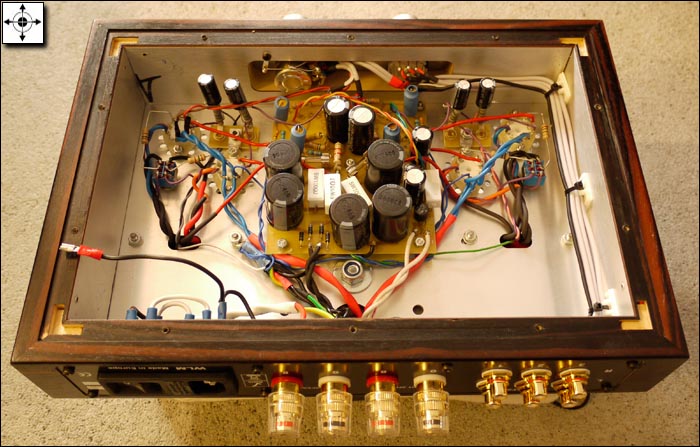
The mini in Minueta refers to the smaller chassis (300 x 200 x 150mm WxDxH) as well as the tiny output tube called 6BQ5 or EL84*. The quartet of output glass here is good for 14wpc in Ultralinear, 5wpc in triode - and class A push/pull in either case. Power wise, it positions the Minueta between single-ended 2A3 and 300B amps on the low side, between 300B and 6C33C SETs on the high. In popular hifi opinion, the EL84 doesn't rank as highly as direct-heated triodes and the beefier pentodes like EL34s, 6550s and 5881s. Yet true valve connoisseurs shopping with their ears and not through the nose know how sonically advanced the Minueta's choice could really be. Decware favors the Russian military version of the EL84 above others, Manley Labs has monoblocks dedicated to it, Almarro's integrated SET was an underground darling and the Glow Audio Amp One runs a pair of 84s. To mention but a few.
____________________
* The review loaner was actually fitted with the WSSSR-branded Russian 6H14П equivalent whose Cyrillic letters become 6N14P in the Latin alphabet. As Wikipedia puts it, "... in the Soviet Union, the 6N14P found application in special equipment and to a lesser extent in more expensive FM receivers and television sets in the 1960s. However, in the majority of medium and low-grade Soviet-produced FM radios, a more general purpose 6N3P/2C51 was utilized as the lower frequency OIRT FM band used in the USSR (65.8 to 7MHz) allowed for less stringent noise figure requirements towards the receiver design and its components than the higher frequency Western FM broadcast band (87.5-108MHz) used in most of the rest of the world."
|
 |
The Minueta doesn't exist just to fill a spot. Hannes Frick is quite vocal. When higher power requirements aren't an issue, the EL84 is his favorite glass bottle. "I just had to have a 6BQ5 model in the line. I've been into tubes forever and through countless expensive amplifiers. Nothing beats an EL84 for bandwidth, linearity, liveliness and speed."
|
|
|
|

|
Circuit and transformer designer Cokic agrees. "The tube has no prestige and costs very little. I can't imagine a cost-no-object statement amplifier with EL84s* selling for €10,000. More than one 300B amp with less power does of course. But this tube suffers the royal bastard syndrome. Nobody mentions it though everyone knows it exists. Most audiophiles equate it with entry-level and don't give it a second thought. I don't agree. I could easily design an EL84 amp that would give even my own 300B monos a run for their money. Naturally, I'd have to charge for the necessary associated parts of that caliber. Then nobody would buy the amp. For that kind of cash, people have been conditioned to expect direct-heated big triodes without feedback, not lowly small pentodes with feedback. It's sad but consensus reality. Only an idiot would try to fight it. So the Minueta for Hannes was deliberately positioned to be his entry-level amp."
____________________
* As described here, I duly commissioned Cokic for just such EL84 statement amplifiers to set the record straight. They'll be mono, ultralinear, class A push-pull, interstage-transformer coupled and loaded with serious iron. Cost no object. Relatively speaking. My Kaivalya monos could clock in upward of €5,000/pr once Cokic's work is done. It'll be reference amplification without any snob appeal. To my mind, this tube is capable of true greatness, operating between a 45 and 300B direct-heated triode, albeit capable of higher power, better drive, lower noise and far lower valve replacement costs. In short, luxury realsization.
|
|
 |
|
 |
|