|
|
|
I asked about gain structure since most DACs give up linearity in their lowest bits, causing deep digital attenuation to suffer audible drawbacks. "We do optimize our gain structure so that the volume control is set relatively high compared to old systems. This also optimizes the noise and dynamic range potential. Old systems which reached max analog volume at 9-11 o'clock are ridiculous and belong to history. Our DACs are actually very linear right into the analog noise floor. This critical parameter we measure, rejecting any that do not behave in this way. We have tested and rejected a very popular DAC for this very reason. Another concern with digital volume control is the analog noise floor on the DAC. For example, x's new platform has an elevated noise floor and really must be used with an analog volume control to maintain adequate dynamic range for high performance audio; even with CD material. I found that for a DAC to behave as theory would predict requires that every aspect of the design must allow it to approach that theoretical limit, especially when the DAC can achieve 128-130dB of dynamic range. Issues surrounding power supply noise and PSRR, PCB layout, master clock noise, analog parts precision and such all become more and more critical when working in this rarified air."
|
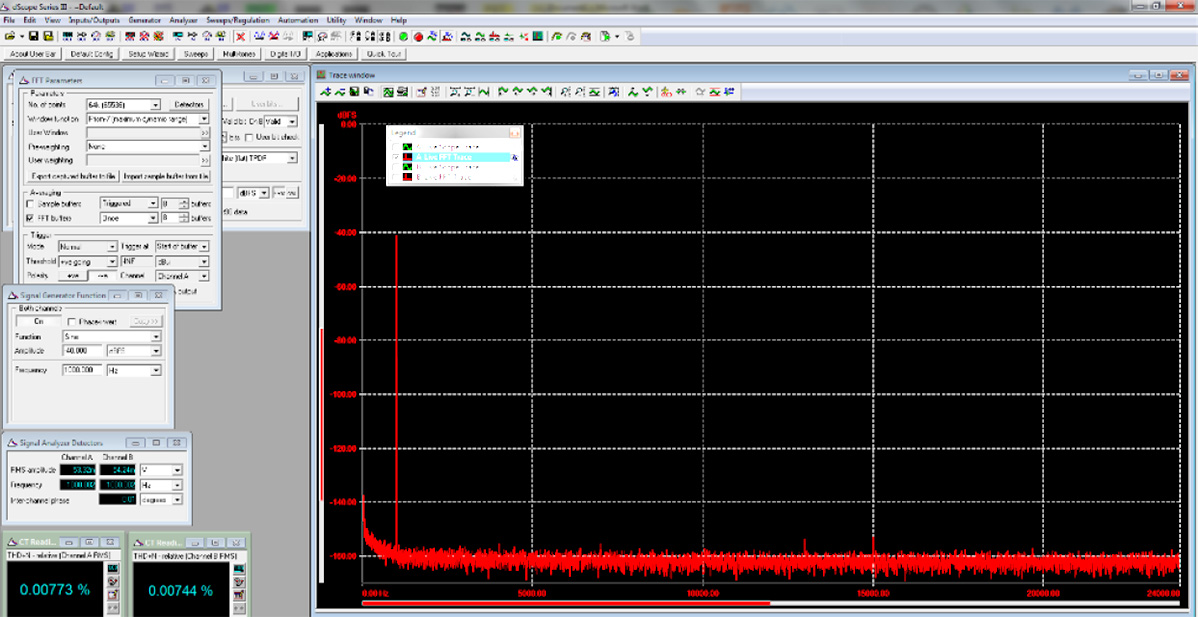 |
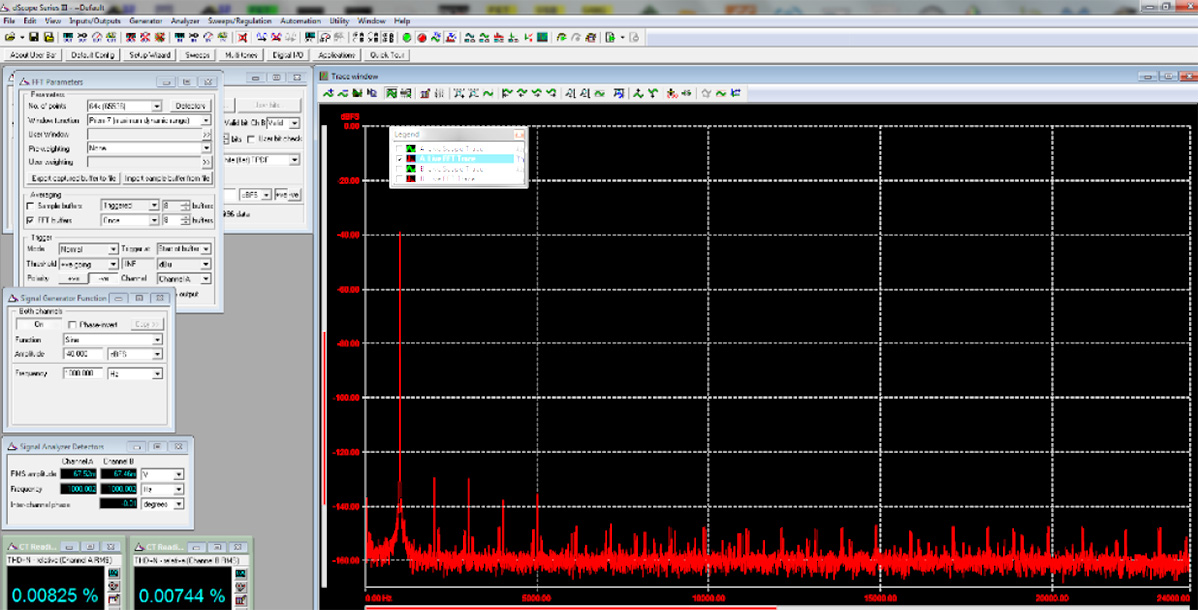
To document the difference, John provided these FFT graphs. Whilst both DACs show an identical 0.00744% of simple distortion, looking closer reveals that only the upper one shows a clean 1kHz signal at -40dB. The other suffers plenty of spurious even, odd and unrelated artifacts above the shared -150dB noise floor "which can render an unnatural 'digital' edge to the sound". Bel Canto's chosen converter for their HDR-II core is "the most refined CMOS processor with superior dynamic range achieved through extremely low noise, distortion and jitter sensitivity. This advanced segment technology DAC combines both multi-bit and multi-bit delta-sigma technology with a dynamic range of 132dB and transparent linear-phase digital filters. The CMOS analog conversion operates in a constant voltage Class A differential current mode."
|
|
|
|
|
|
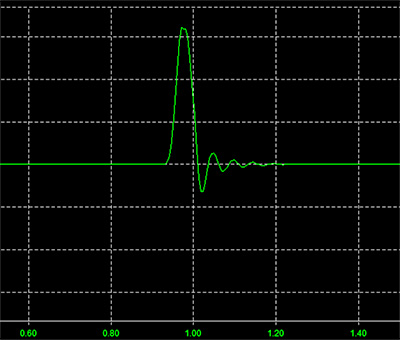 |
Bel Canto's 2nd-gen HDR-II core starts with "ultra-low phase noise free-running master clocks fed from dedicated ultra-low noise analog power supply regulators. Two stages of asynchronous interfacing ensure that the final DAC output is jitter free and independent from any noise on the incoming digital signals. Our custom MQA-based digital filters define an optimized impulse response from MQA, PCM, analog and DSD. Our graph shows this impulse response with a 44.1kHz CD test signal. Our custom digital filters largely mimic the time domain response of an audio signal traveling through ten metres of air."
HDR-II's differential analog output stage has "its large constant-bias differential currents impose pure Class A operation to every part of the analog output stages. Every precision resistor, film capacitor and amplification device is biased with constant current and voltage. This keeps all components in thermal stasis and insures that all the original signal dynamics are retained."
When added, a single-stage folded cascode amplification module with >500mA of peak current capability "maintains very low constant distortion levels through the audio band because of its high open-loop bandwidth. This SSHA module brings a further element of dynamic resolution and contrast to the HDR-II core. The vertical modular design permits a tight efficient PCB layout which combines the best of IC-based and discrete component design. The PCB represents a final degree of design refinement that is especially critical when the circuit is capable of 130dB dynamic range or more." |
|
As to the Bohmer room correction, "yes, just typing in room dimensions would be convenient but the 3D models and equations to support this would be very onerous and limit application to quite simple setups and assumptions. The Bohmer method uses a very simple and repeatable measurement compared to most. The microphone is placed 4 feet from each speaker and each speaker is tested in situ using a single sweep. This data is then uploaded to the Bohmer servers where the heavy calculations are done. Then a coefficient file is downloaded from Sweden to the customer's system with their custom filter coefficients."
Being configurable as just a DAC; DAC/controller; or DAC/controller/amp = integrated... Bel Canto's new Black EX platform promises cutting-edge modernity, modularity and masterful multi-tasking. |
| ... to be continued when first production commences... |
|
|
 |
|

|
|
|

|
|