 |
|
|
Firing up the Aries revealed a low-contrast black-on-orange display with the cursive company logo in fuzzy lettering. Once it set itself to showing selected input and volume, the blockier font sharpened up but still would be hard to read at my usual 4m distance. Once I'd inserted two AAA batteries into the shiny metal wand, changing volume by remote clicked mechanically through the resistor array's relays at about two clicks per second. Yet it produced zero switching transients through the speakers. (Bypassing this often not perfectly managed side effect has some extreme manufacturers like Germany's Gruensch actually run two circuits - one to switch the relays, another to insert itself momentarily during switching and conceal clicks through the speakers.) Hitting the menu button on the face plate brought up the high/low gain option. That is assignable separately to each input. I initially selected 'high', figuring that if this adjustment involved feedback, it'd be lower in that setting; or if a voltage divider, one less resistor*. I'd then compare that against low gain to see whether, like in my 0/12/24dB adjustable Esoteric C-03, this acted like an analogue EQ of sorts (faster, leaner, drier with low gain, fatter and denser in high gain). To take the Aries' measure by just changing one thing at a time, I reverted to the FirstWatt F6 amplifier.
|
| ______________________________________________________________________________________________________________________________________________________ |
* "The amplification stage is class-A single ended with no feedback. There are two separate gain stages, one with 6dB gain and one with 9dB gain. So I simply switch between the two."
|
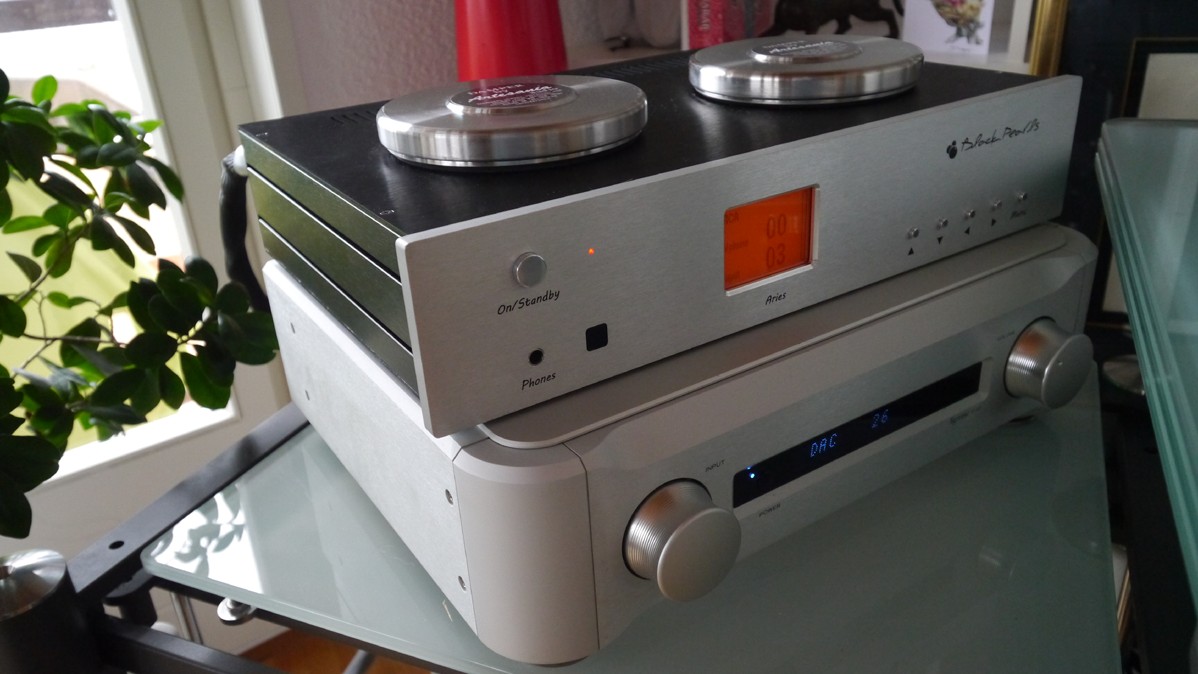 |
The difference in display contrast between the Black Pearls and Esoteric units is visible even from this oblique angle (this diagonal position creates line of sight from the listening seat).
|
At first I thought the Aries was permanently stuck on mute when, at 10 on the dial, there was no sound.
It turned out that even in high-gain mode, the attenuation taper above zero was so shallow that I had no useful output prior to 25. I actually needed to hit 45 before I had low room level. Obviously this varies with source and power amplifier gain plus speaker efficiencies. I'd much rather have a lazy taper than one that comes on too sudden to abolish fine gradations between nada and hollering. As long as one has sufficient gain for all occasions, it's actually preferable to invoke as little attenuation as possible. Only misinformed punters would refer to that as "not powerful enough" should their volume control end up at 75% or higher. Experienced listeners appreciate how that doesn't burn off as much signal as throwaway heat.
|
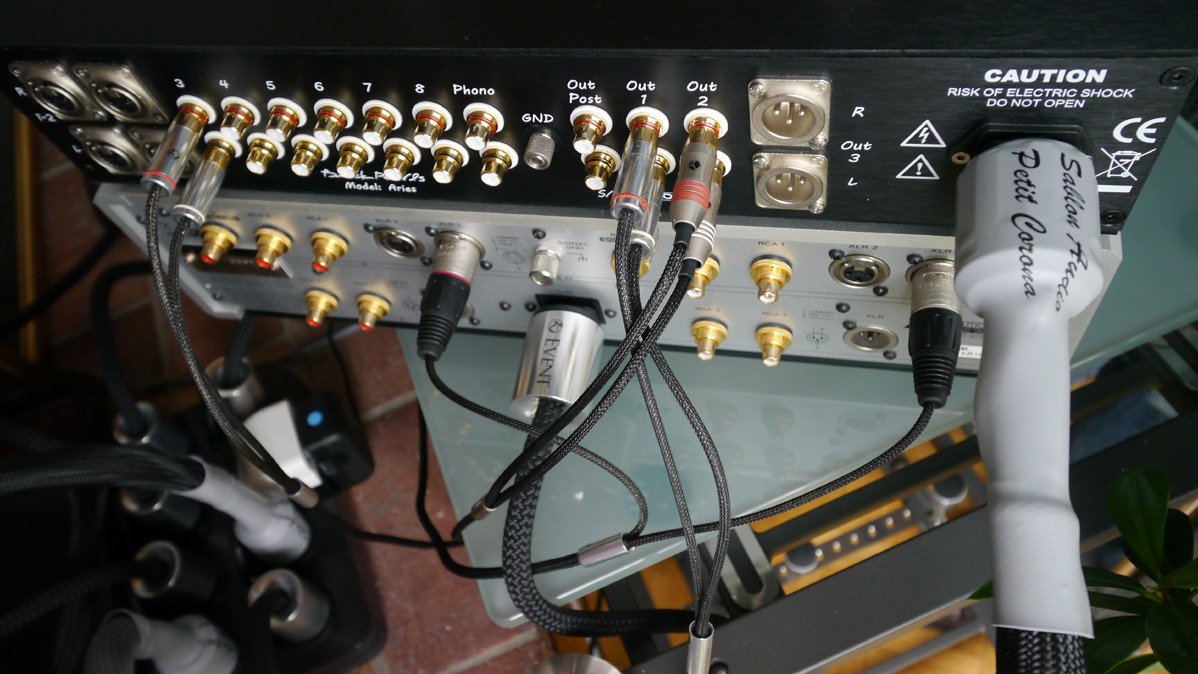 |
Though 'post' on the third preout is perfectly logical for 'post attenuator', 'fixed' might make this fact even more obvious to prevent heart-stopping surprises.
|
The offset of gain between the two options was so small that I detected no significant sonic impact except for thinking that, perhaps, high gain was a tick fuller. Relative to the Esoteric, the general gestalt of the Aries was set to between the former's 12dB and 24dB options. It veered into the slower rounder fatter half of the equation whilst still missing the C-03's max expression of that particular aesthetic. Resolution gauged by separation and contrast sharpness was good but not exceptional. Just as had the Taurus—and the Birth 100 before it—Mr. Papachristou indeed applies a one-size-fits-all approach to voicing his components. Unlike certain Chinese lines which differ from model to model in a something-for-everyone mentality whilst making predictions impossible and the designer's sonic ideal anyone's guess, the three Black Pearls Audio decks I've heard are perfectly consistent. If you put yourself into the hands of this designer, he won't betray your trust by suddenly acting like someone else. If you thrive on the frisson of transient blister and adrenaline, this won't be your cuppa. If you fancy a bassier warmer presentation that's closer to mid-hall amplified live sound, Konstantinos has your number. |
|
|
|
|
|
Further proof of that bread pudding came from jacking my ALO-wired Sennheiser HD800 into the 6.3mm jack. This neither mutes the main outputs nor does it scale down gain. Once you've swallowed that surprise, the next will be that speed, space and top-end tuned cans like these suddenly change their stripes. Without simultaneously retaining the trademark airiness of for example the musicbook:15 player/DAC/preamp/headfi multitasker whereby Lindemann manage a similar bodybuilding exercise albeit with wirier slammier bass, the Aries skips the whipped egg whites for spatial fluffiness altogether. It goes straight for the meat and gravy after the pumped-up gym session. Again, this was perfectly consistent and smashingly effective on the HD800 if less so on an AlphaDog or LCD-2. There this treatment didn't provide the necessary counterpoint. Meanwhile the HifiMan HE-560 as the HD800's planar brother from another mother was just as happy on the Aries again. On the debit side of this headfi ledger was a bit of power-supply hum at actual listening levels; and a somewhat rude turn-off transient when I powered the deck to standby whilst still wearing the cans.
|
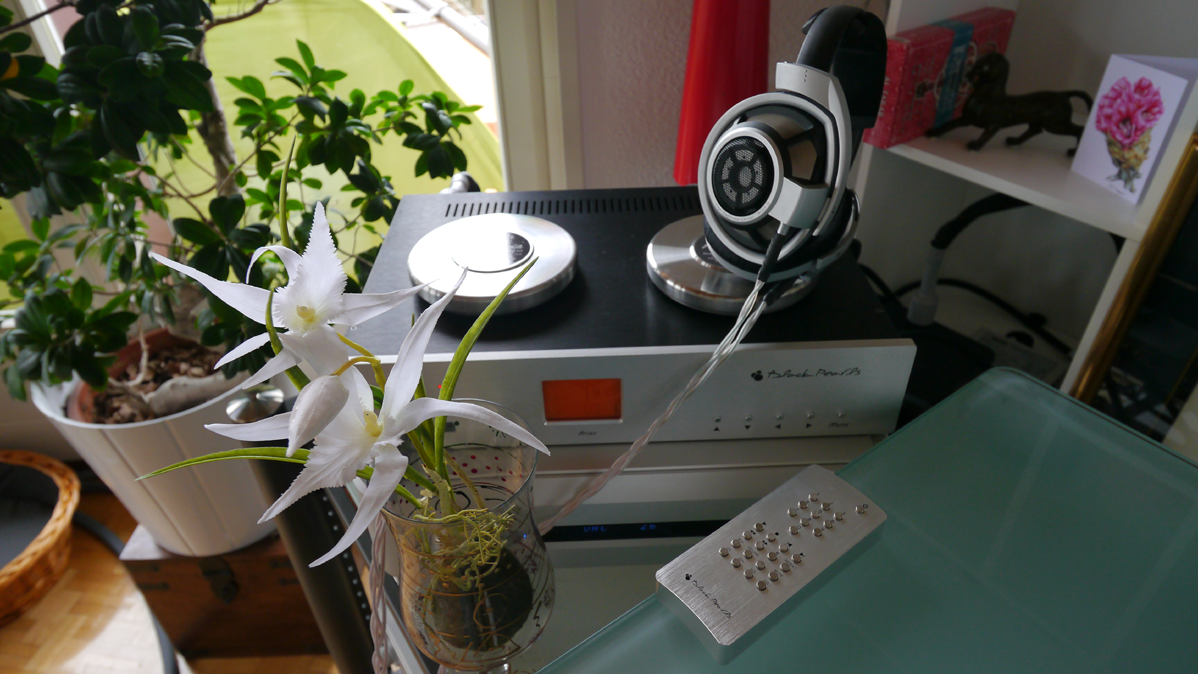 |
Without apparent reason, the display would sometimes go blank orange and not revive with input prompts like volume changes. Even when it didn't as here, it was hard to read. "This is not normal. This might have to do with the display cable you found disconnected. I assume when you put it back, you pressed it down all the way (I did and checked again). I never had this problem so
it is an indication of a faulty display or cable. Since the unit is still functional, it means the processor works okay."
|
This excursion cemented an overall impression that had formed at this juncture. It's about the audiophile journey through the four seasons. It used to be that entry-level gear lacked resolution and refinement but did chunky quite well. One then progressed to snazzier boxes, subsequently better electronics and so forth. All these steps were expressions of a race after increased resolution. One meant to hear more and more of the many stereo and hifi effects reviews talk of. Yet more often than not, this pursuit ends up in the deep of winter. One has extremely high nearly black'n'white contrast starkness to admire each musical tree's arterial fine branches. Sadly all of fall's colourful foliage has fallen to the ground too and the general temps are a mite chilly. The Black Pearls Audio voice stays true to beginner's chunkiness but adds more resolution. This moves up into a higher class or different season. It goes past summer's bright sun and settles somewhere in the early autumn on a day that's just a bit overcast but still sports all the leaves. Of the many show systems I've heard, one which consistently expressed a similar view on things was the Danish Gato Audio room with its paper-driver/soft-dome speakers and warmish Pascal-based class D integrateds. Where Taurus and Aries would still fall far behind in that comparison is their mechanical execution. They neither look as slick nor are they as well and elegantly put together.
|
 |
|
|

|
|

