|
|
|
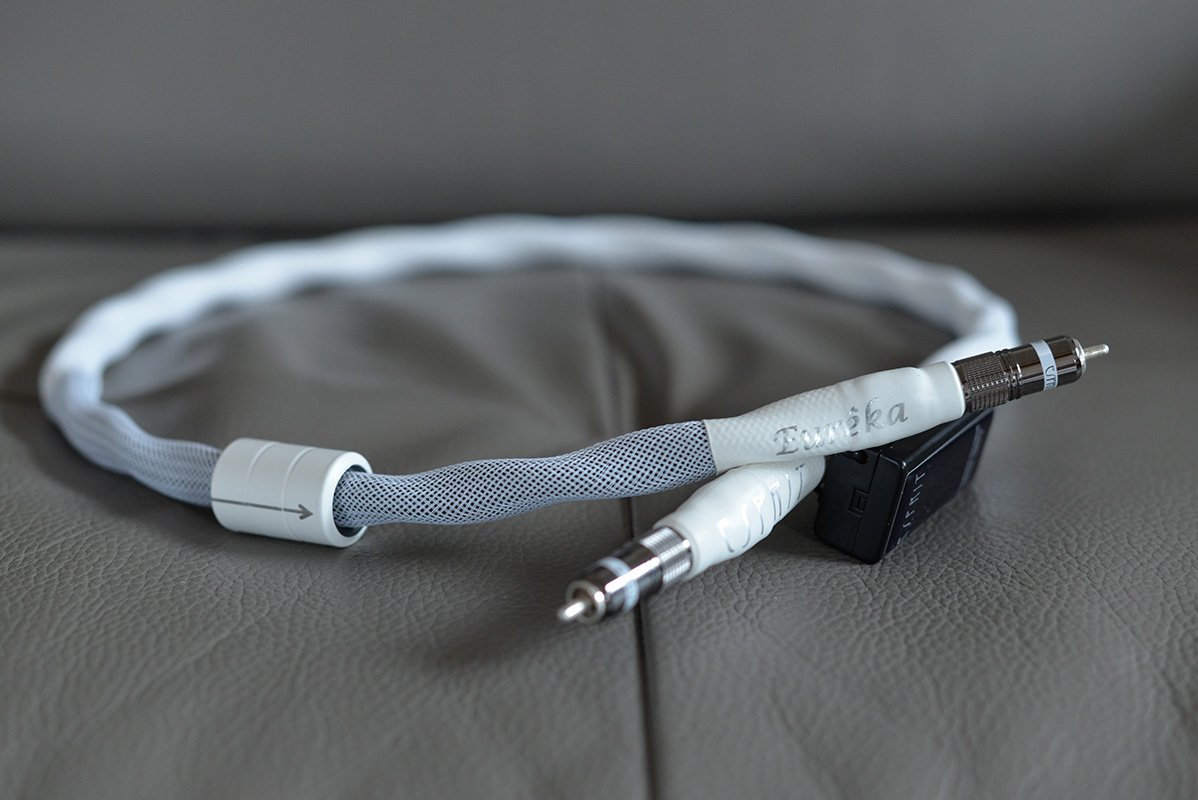
The best results with the Eureka interconnects placed them between source and preamp. Adding another pair between preamplifier and power amp slightly improved the sonic result but not to the same extent. As my system and equipment are mainly balanced, I had a slight preference for the XLR cable but what the Esprit unbalanced interconnects achieved was very good and not that different from the balanced version. Listening to simple piano works like Christian Chamorel's last outing of Mozart piano works on Calliope, the midband acquired more density than with my usual cables. The Grimm Twisted Pair Master interconnects is said to be the least microphonic cable in the industry by a margin of 20dB thanks to their bonded semi-conductive interface layer under the shield. They provided a bit more ambient information but their tonal balance was brighter to result in this different equilibrium. Eureka undoubtedly added more texture and density. They provided plenty of colour but not a systematic colouration of their own but rather, more diversity of timbres. It was admittedly more difficult to assess their performance as I was compelled to compare my top-range bi-wired Coincident Speaker Technology CST Statement set with Eureka's single-wire loaners. Esprit don't include in the Eureka range any bi-wire option. It was thus impossible to distinguish what was strictly related to the cables and what to the jumpers to force my bi-wired reference into a single pair by connecting two spades to the same terminal. The CST did not have the profusion of tone but more dynamics than Eureka which was more laid-back but still delivered more energy in the bass. Eureka's 3-meter capacitance was equivalent to my previous Lumina loaners to suffer neither stress, harshness nor impedance issues.
|
 |
|
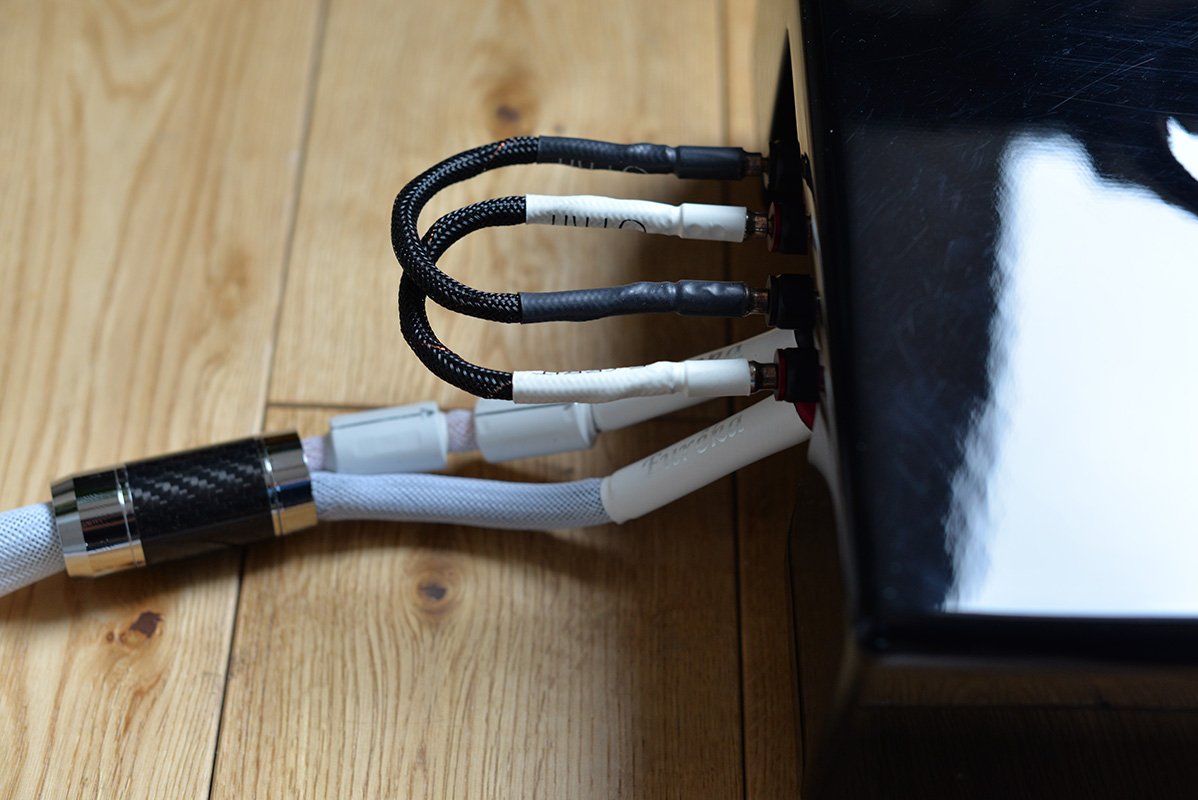
They provided energy and resolution in the lower midrange to have me assume very low internal resistance as was already the case with Lumina. As Richard stated, here capacitance isn't as vital as long as it remains reasonable. A speaker cable's capacitance sits in parallel across the power amp's output, not in series with the signal. Therefore, loudspeaker cable capacitance has very little deleterious consequence upon the accurate signal transmission across the length of the cable. On the other hand resistance—and even more significantly, inductance—have very profound effects except that Esprit don't disclose those two parameters. Cable resistance results from its cross sectional area and conductor material. Generally the larger the gauge, the lower the resistance. Low-resistance cables have a low propensity to shift frequency response with a given loudspeaker while high-resistance cables have a higher propensity. Hence the sonic impact of the cable will depend on the speaker's impedance curve. A high flat speaker impedance will cause little to no response deviations even with a high-resistance cable but with a loudspeaker of impedance fluctuations, a high-resistance cable will superimpose more of a response deviation.
|
 |
|
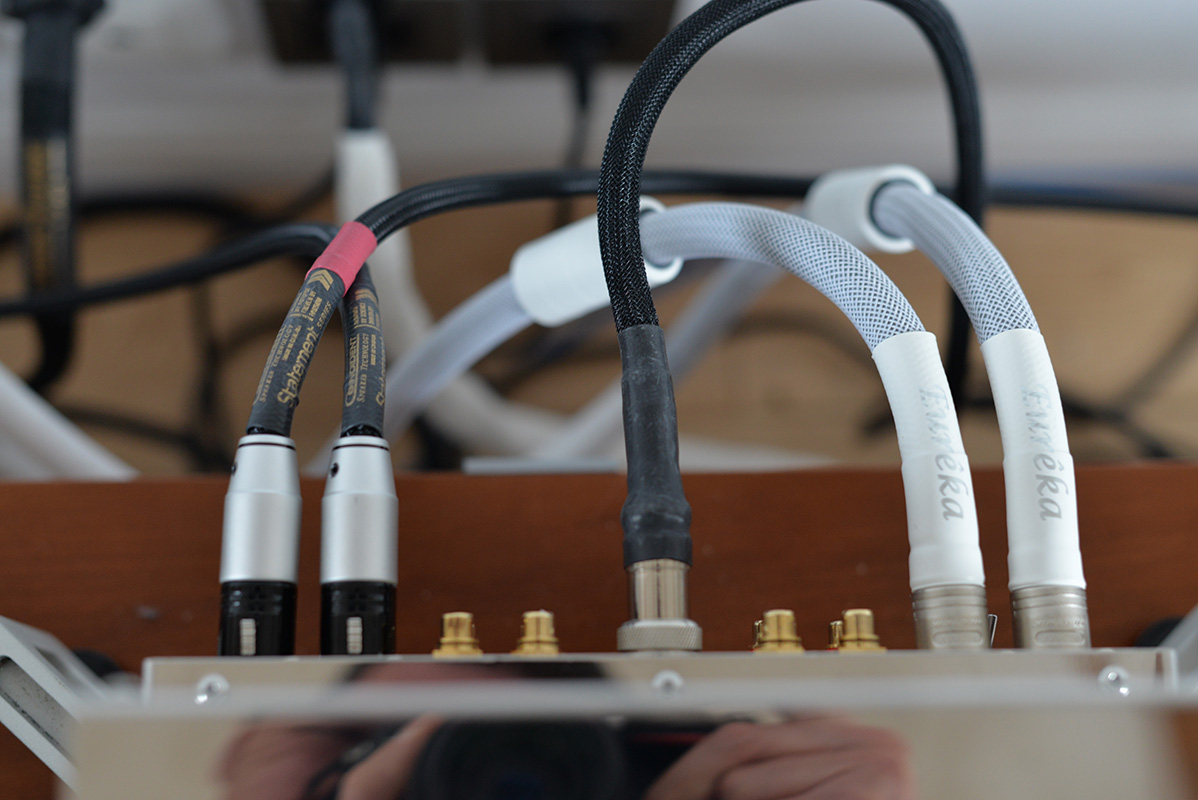
Calling on memory, Eureka seemed to provide more detail and softness than the previous Lumina loaners. The slight gap in energy and dynamics compared to the CST Statement and my recall of the Lumina speaker cables was easily filled with the Eureka power cords. That could count as a greater synergy between the various Eureka types but I would rather consider it a kind of compensation between speaker cables and power cords. In fact, all Eureka cables follow the same direction and it will depend upon your own taste to increase or decrease this contribution in your system. Usually high-end power cords boost dynamics and that was the case with Eureka. The ultra-low inductance of my CST Statement cables brought higher extension of the treble. In comparison, Eureka was a bit duller especially on piano recordings. Christian Chamorel's right hand had more precise attacks with the CST whilst his left hand had more weight, authority and nuances with Eureka. Both speaker wires brought out plenty of spaciousness and scale and I couldn't distinguish a winner in these areas.
|
|
|
|
|
| Eureka's performance was spacious, extremely smooth and noiseless. The silences and spaces between sounds were perhaps the best I ever achieved. In my opinion that became the most important feature of Richard Cesari's top speaker cables. They delivered the highest silence without disturbing rhythm and musical flow. When the entire Eureka loom worked together, the strengths described only compounded, especially the noiselessness and detailing in the lower mids. Being a power cord skeptic, I must admit that Eureka brought further silence and definition when used on both preamplifier and D/A converter. They also produced quite good results on my two bridged Luxman amps which was quite an achievement as these usually prefer their stock power cords. The very percussive first movement of the Poulenc Concerto for two pianos [Martha Argerich in Lugano] sounded delightful. The Esprit loom gave weight to the music whilst avoiding to kill the soloists' most subtle inflections. During the very loud passages, the two pianos remained very articulate and clean whilst the orchestra had more presence than what I usually get. Yet my system's flaws were now less glaring and almost all of its better qualities seemed enhanced. It was particularly obvious on this concerto at realistic volume which can easily become tiring in the long run. It was as if my whole playback chain had been given an easier task.
|
|
Using the two power cords with my class D SPEC amplifiers, the result was slightly different than with the Luxmans. The mono-strapped RPA-W3 EX naturally deliver very tight robust bass. Introducing two Eureka cords into their game put further emphasis on the low end and did not provide the same balanced response as when the two SPEC amps run on their stock cords. The Eureka interconnects however produced astounding results with the RPA-W3 EX. Using Eureka cords on my class D Red Dragon S500 monos made results of the exact opposite to the SPEC amps. As was already the case for the Lumina cords, the Eureka loaners outshone their regular mains cables. The soundstage acquired far more density, depth and scale. As the two American switching amps are already very precise with a lot of treble finesse, this was quite a match in heaven without regard for the associated loudspeakers. This mitigated impression about the power cords highlights once more that their outcome is never certain. As nothing is guaranteed in advance and considering the price asked for just one Eureka mains cable, a prior audition in your own system is strictly mandatory.
|
 |
Conclusion. Summing up, the new Eureka loom brought further textural realism and presence, an emphasis on musical flow and momentum and greater smoothness on top. This outstanding performance has an unfortunately hairraising price and it's in my opinion required to test in situ these accessories before committing to any binding purchase. That said, the interconnects were pure gems to my ears and have me assume that they might deliver stratospheric performance in different systems. They were the best interconnects I ever plugged 'n' played and thus a new personal reference. Despite their prohibitive sticker, I'd view them the real bargain of this loom. The other Eureka types share the same DNA to consequently express the same characteristics. The full Eureka loom makes instruments on Baroque recordings sound more substantial and less fussy. If you can afford them and are looking into this specific direction of getting more substance, these cables should be on your list. Are they then worth their ask? Difficult to say. If I consider the time spent by our little company to design and build some evidently noiseless cables; or the simple fact that the maximum quality in listening to recorded music will be your top priority and your pockets are extremely deep… then yes, I assume you would do everything in your power to improve your system, including this. But I would also say no as it's commonly considered unreasonable to spend €45'200 on a cable loom which could otherwise be allocated to a beautiful German car [ sez our Frenchman, Citroën be damned? – Ed.] The only final call I am going to make for such extreme choices is to reiterate that the Esprit Eureka interconnects were the absolute best I've thus used and not by a small margin.
|
|
 |
|

|
|
|

|
|