 |
|
|
Part II. The overkill conundrum. Let's face it. When one encounters then acquires an amp which does the business better than any one heard before, one tends to be entirely ignorant of whether less might have done just as well. In short, unless one didn't know when to stop—which is, to settle down and enjoy, not continue comparison shopping—one never appreciates or even worries about whether one is guilty of overkill. For once I would worry because the F7's design brief includes some of the authority of bigger amps without their massive hardware. Given that I own the Pass Labs XA30.8 which, though rated at 30wpc/8Ω actually does 90 watts before hitting 1% THD and exploits 20 not 2 transistors per side, probably three times the heat-sink area and a far beefier power supply with concomitant weight increase to illustrate the "with hardware" counterpoint to the F7... I had perfect opportunity to question my situation. From speakers like the 85dB EnigmAcoustics Mythology M1 super monitors to the 87dB German Physiks HRS120 full-bandwidth omnis; from the 85dB transmission-line Albedo Audio Aptica to the 92dB impedance-compensated Sounddeco Sigma 2 and 93dB augmented widebanders of the soundkaos Wave 40 - was our XA30.8 overkill? Would/could the F7 do just as fine a job? If not, where and how did it fall short? At $6'500 and given its specs, one naturally expects the smallest Pass Labs stereo amp to fly the taller flag. But did my loads and listening SPL exploit its advantage? Or was the XA30.8's true potential sitting there sadly untapped, like a V12 taken out for a grocery run on sunny smooth roads?
|
 |
With our Warsaw contributor having focussed on more intuitive speaker mates, I would mix it up just because.
With my F5 the acknowledged godfather, I had a second meaningful comparator to learn whether the F7's different feedback scheme manifested in any obvious way into speakers which until now had never really been a focus for this brand. With our FirstWatt rookie Dawid Grzyb having turned into a serious admirer after just one date whilst exposing sundry of his colleagues to the virus, that loaner was duly booked for further Polish adventures. Nelson hence volunteered to dispatch a second one to me rather than wait for the first one to bounce back. Dawid's comments already painted quite the picture of course. To recapitulate, on his 87dB Boenicke W5 minis, he categorically favoured the F7 over the far drier 175wpc $5'200/pr class D NuForce monos except for the bass. On the 100dB Bastanis widebanders, the F7 pulled even with a €14'500 Swiss 100wpc Mosfet amp, was much quieter and generally richer but again not as articulate in the bass and also less explicit in the treble. On 98dB Polish widebanders in concrete, the F7's milder warmer character was a far better match than the $5'500 500wpc Sanders Magtech which might actually have overdamped that load. On the 92dB Blumenhofers, it boiled down to different flavour/preference like against the Nagra, not a KO. According to Dawid's comparative opportunities then, the reach of Nelson's $3'000 contender extended up to 5 times its own bill and with an intrinsically happier match into a given load, could be decisively superior.
|
|
|
|
|
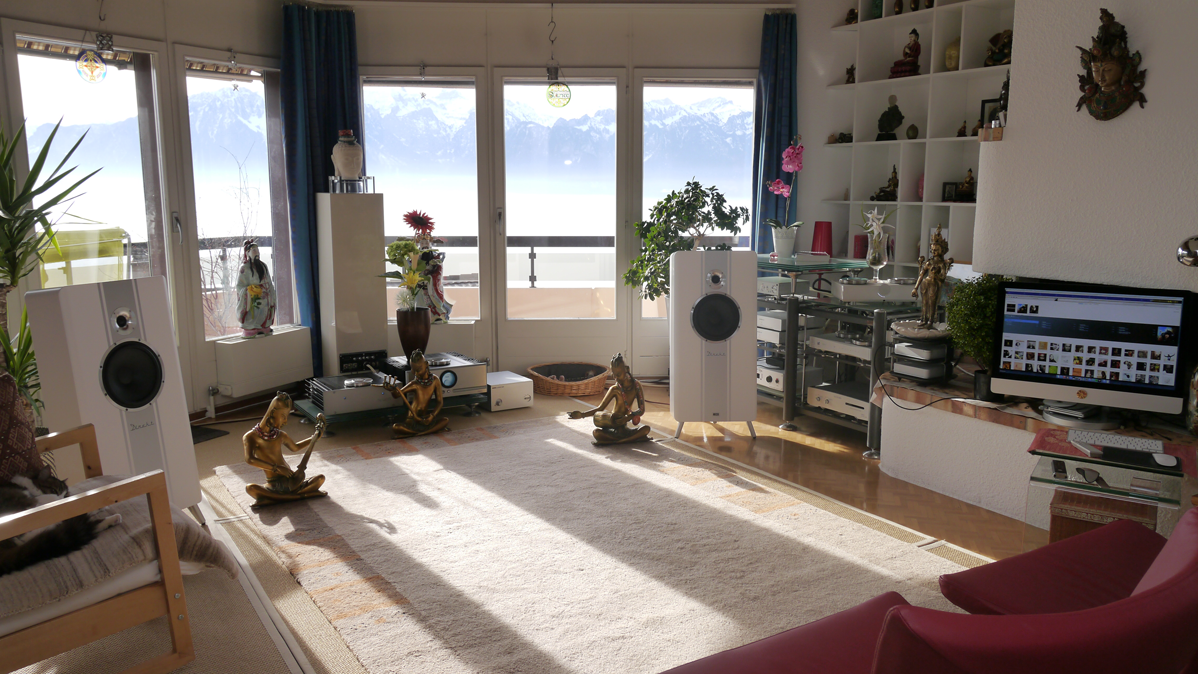
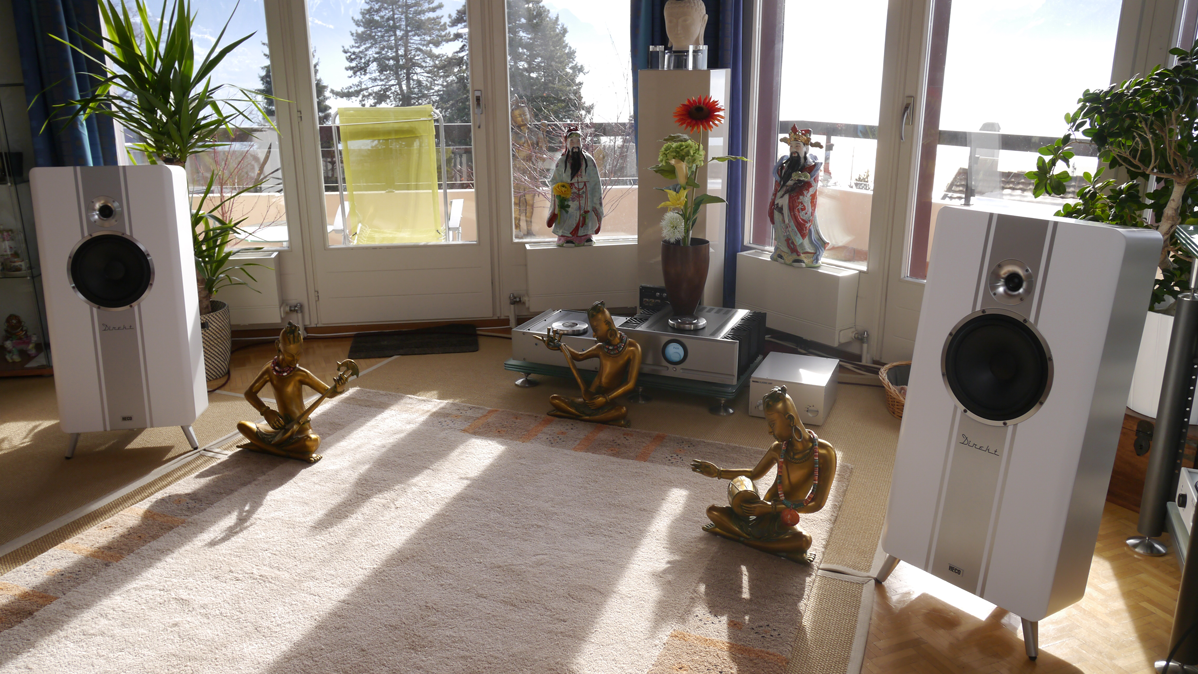
XA30.8 versus F7 on Heco Direkt. Still in from their review to come first before this opportunity flew the coop, these Germanic retro-inspired 11-inch 2-ways with twin downfire ports, broad shoulders and skinny butts claim 95dB in-room sensitivity. This easily filled our 100sqm listening space with standard volumes at a good 10dB below unity gain (2V DAC) off even a small 8/15wpc into 8/4Ω 6V6 push/pull valve amp, no active preamp gain required. Such speaker efficiency signs peace treaties with low-power amps. For this occasion, it'd turn the F7 into a minor muscle champ. However, it's not just satisfactory loudness, current delivery and low-impedance stamina which factor. It's high-impedance power delivery, too. As can be seen from a German print magazine review, the Direkt's port loading creates the typical saddle response. Its twin peaks occur at 28Hz and 70Hz with 22/23Ω magnitude. Into such impedances, most amps deliver only about <1/3 rd their 8Ω rating. If the 8Ω figure be marginal, it's obvious how higher SPL and peaks will compress and attenuate this speaker's mid/upper bass areas. And that's exactly what I heard with the S.A.Lab Blackbird whose power is just like a 300B SET. Despite benign efficiency, its bass performance suffered by contrast to the XA30.8. But it did not on our 92dB less sensitive Sounddeco Sigma 2 whose complex 1 st-order filter includes deliberate impedance linearization. On the Russian tube amp, the less efficient speaker with dual mid/woofers had the clearly more linear and butch bass response. All this to say that shopping on bare efficiency is overly simplistic. There's rather more to what makes a speaker an easy lay.
|
 |
|
 |
With the F7's 8Ω rating being quasi excessive for these purposes, I didn't expect any bass linearity issues against the XA30.8 though liably an offset in weight. And reality did behave itself against theory. On LF evenness, the Pass Labs had no audible advantage even on deliberate bass buster tracks. It was, however, undeniably more forceful and heavy down low. That aside, other offsets were of the mostly ambiguous flavour/taste rather than the unequivocal better/worse type. For a fabulous newer voice by the way, check out Azeri Jazz singer Sanam Abdolazimzadeh's "To Poshte Dar Nisti", "Vertigo" and "Tabriz" on YouTube or via her FaceBook page. Back on audiophilia, imagine the soundstage spreading out in front of you like a hand-held fan, your seat at its head. The outer guards pass by the outsides of the speakers. The fully opened leaves end well behind them in a broad arc. Wherever on this fan a performer or instrument falls, there's a very clear sense of individual distance, from it to your seat aka rivet point. If each instrument connected to one, you'd know how long to make its specific rib of our fanned-out stage. Hifi lingo calls such distance specificity layering or throwing highly articulated depth. Both amps excelled at this equally. The difference was whether I first 'saw' space or content. Let me explain. It's very basic.
|
|
Sound obviously is always about both the space in which it occurs—with playback not only your room but also the recorded venue—and what happens inside said space. When you key into one, you don't exclude the other. They always coexist. Just so, you can view either the leaves of a tree or the negative space between and around the leaves. Some reviewers, yours truly included, distinguish between these two perspectives as "I'm there" versus "they are here". With the Pass Labs being the more robust, chunky and punchy, it inhabited the "they are here" option. This was all about deep incarnation. With the FirstWatt the gentler, lighter and more spacy, it expressed the "I'm there" version. Given that this speaker's use of an 11" Kraftpaper mid/woofer up to 2'350Hz makes it a beef eater with a built-in dense very substantial midband and presence region, the XA30.8's extra bass power and shove made the combo ideal for amplified listeners. By that I mean those whose reference is a club, arena or stage with sound reinforcement. It's about mass, loudness, scale and dynamic swings. The F7 more played to acoustic listeners. Such concerts—usually in smaller venues unless symphonic forces are involved—make for smaller, lighter, less bassy individual sounds. They don't overlay space to the same extent, hence qualities like reflections, reverb trails and separation tend to be far more pronounced.
|
 |
Obviously a lot depends on a recording's quality. How much virtual space was captured in the first place? On a plaintive love song to Baghdad the ancient city, by one of Iraq's legendary old singers accompanied by no more than simple guitar and string pedals, later a mourning violin, the F7 really illuminated the sonic bubble around Ilham Al Madfei. This halo enveloped his voice in reflections which lit up recorded space. The XA30.8 did it as well but again, its emphasis was on physicality. If one asked what caused this effect of more pronounced hereness, one might point at crisper leading edges which, by implication, the F7 must have handled mellower. For our purposes, we have many more speakers to go. On the Heco Direkt, I ultimately thought the $6'500 XA30.8 the better match. Its higher current delivery lit the hotter fire under a speaker whose inherent voicing is buxom and a bit lazy, never mind a sensitivity figure which would seem to promise 300B bliss. Not necessarily. That the very same XA30.8 qualities wouldn't overshadow the F7's charms load regardless we'll appreciate with our next (less efficient!) speaker example.
|
 |
|

|

|
|
