|
|
|
Though analog in did show a small loss in quicksilvery directness like a very fine veil, it was far from a problem. What else could you get for this coin that'd do better? A Job preamp and stereo amp already double the outlay and don't yet include a DAC. What if one compared the integrated directly to a Job 225? That's why I picked the QP1R in the first place. One needs a source with digital and analog outputs, the latter of the variable sort. I only had one source like it. Using its analog line-out in flexi not fixed mode for the 225, its Toslink for the INTmate, I had a perfectly fair A/B to generate some flak for or against one of these Jobs. Or so I thought. I even set the Questyle to low gain to minimize its own attenuation and offset the 225's high 35dB of voltage gain. Presumably the portable's volume also works in the digital domain. I simply never got a conclusive answer to that for my earlier review of it. To be honest, I was taken very aback by the INT's clearly more exploded spatiality, more finely honed specificity and separation. The 225 sounded a tad muddy, murky and dark by contrast. And it staged blatantly more compact. I suspected the QP1R's attenuator, output stage or both. I simply couldn't narrow it down. I was perfectly willing to declare an INTwinner. I was plenty impressed by the time I'd gotten this far. I'd just expected a smaller margin if that. I thus remain suspicious. My comparative setup must have unfairly handicapped the 225. I simply didn't have another source that would have made for a relevant comparison. Therein lies the bigger rub whenever one means to compare the INT. Unless it's to another uni-boxer like itself, it's really a no show and no go. With how the INT is configured, you'll never know what the DAC, DSP and output stage bits contribute. You can always only assess the full combo.
|
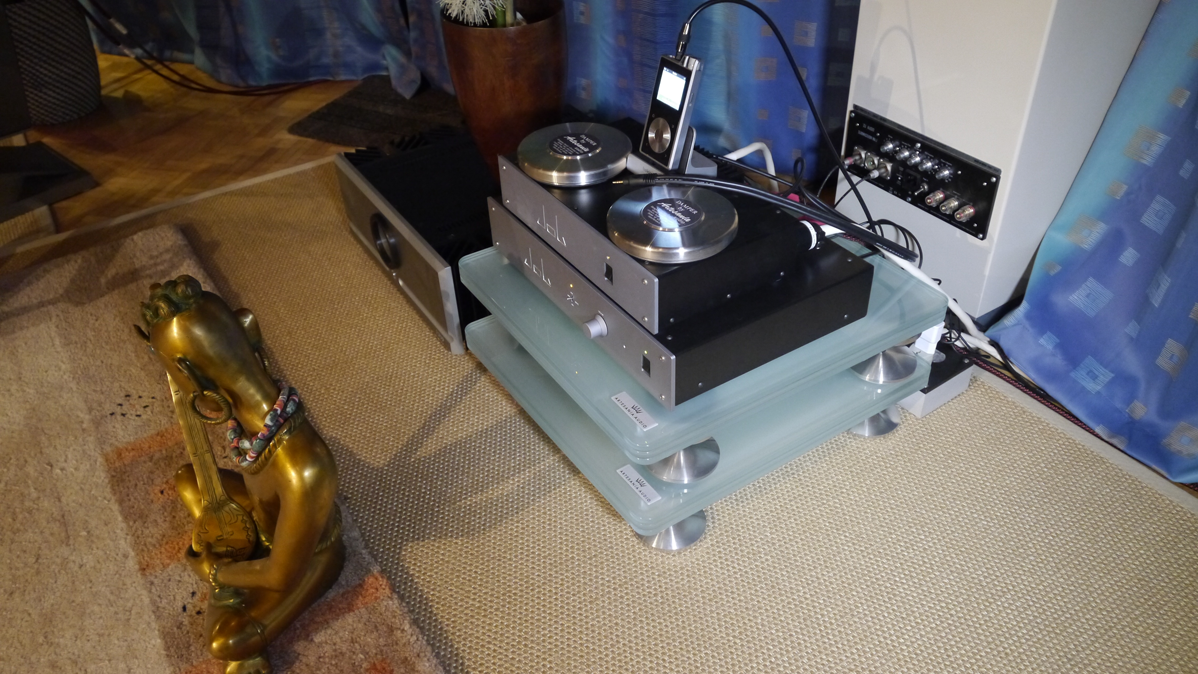 |
The Job 225 is both narrower and shallower than the INT.
|
Now I resort to living memory which, by owning a Job 225, I have constant opportunity to refresh. I really know its sound in various system configurations around our crib. It's a lit-up-all-over presentation with textural gloss, great liveliness, massive detail, wiry not fat low bass, very defined but not heightened upper bass power and superb intelligibility. It's a modern highly resolved fast wide-open perhaps slightly cool and crisp sound. With properly endowed speakers, soundstaging is nearly holographic. With the wrong speakers or ancillaries, things can get too lean, bright, cool and forward. The INT reaches into the same grab bag but strikes me as a bit mellower and warmer. That's back to the 'aged' bit of ripened maturity. It seems to have toned down some on top and put on a pound or two in the middle. Fed with a digital signal, the end result was unquestionably on par with a Job 225 fronted by a €3'000 Metrum Hex DAC and passive preamp; possibly slightly better. It was definitely no worse. Cause for pause and greedy paws.
|
|
|
|
|
Waving the flag, not flying the ship. The thing with giant killers is, they hardly ever do. That whole notion is just silly. It's like believing a Nigerian mail fraud where a philanthropic billionaire randomly selects you as the recipient of $25 million. Too good to be true. Instead of giant killer, why not just say a very good value? Or top pick at its price? With the Job INT, I'd sign off on anything that reflects nearly shocking value without simultaneously insinuating a reset of the audiophile universe. For a true reboot of our small world, one would need familiarity with everything at this price to be credible and factual. Nobody is. I am comfortable though in declaring the Job INT as the line's current flagship; and as a serious backdoor into the Goldmund sound for a fraction of the cost. Already the Job 225 was that but the INT is so even more. Its sonics tie to Goldmund's present-day speakers, all active and comprehensively DSP'd, with wired or wireless digital inputs.
|
 |
|
 |
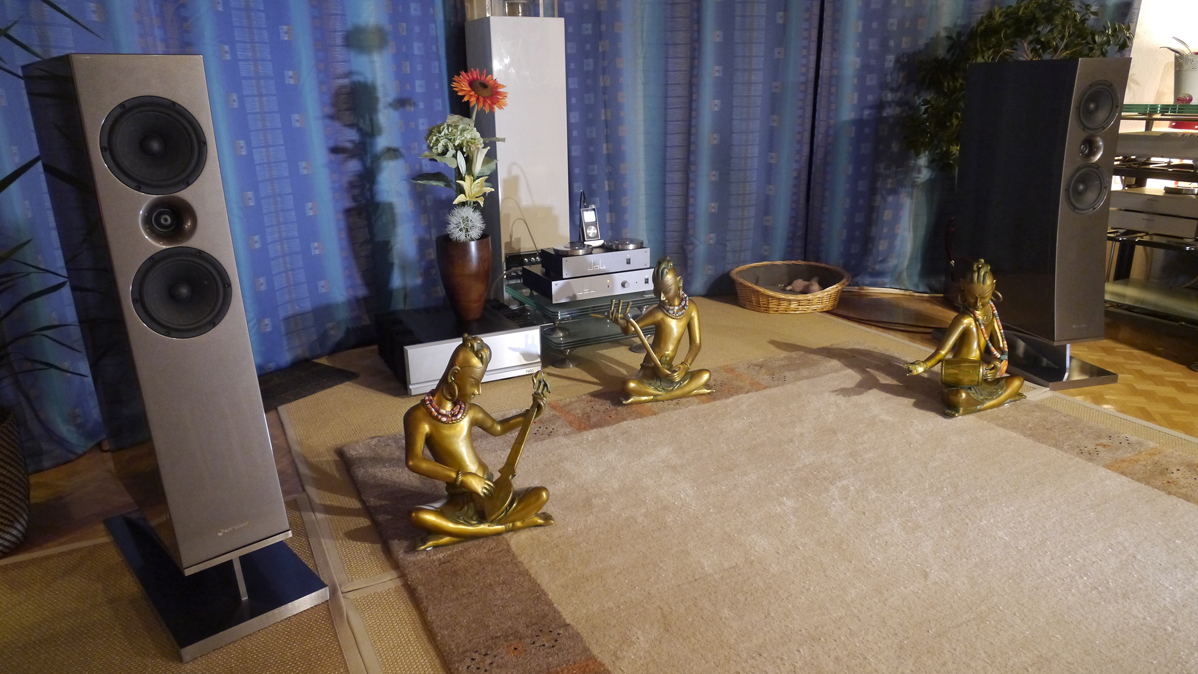
Whilst one could fight with the perception that Goldmund seem to believe their DSP can fix anything, it's far harder to argue with their results. Goldmund speakers don't go after hard cones and domes to ride the diamond, beryllium and ceramic fashion. They prefer high-quality more 'vintage' Scanspeak-level cellulose and cloth. They sound warm, settled and very dynamic, not hyper resolved, nervous and edgy. The INT inherits some of that aesthetic especially when matched with 'similar' speakers. That it prioritizes digital inputs too borrows from Goldmund's current focus.
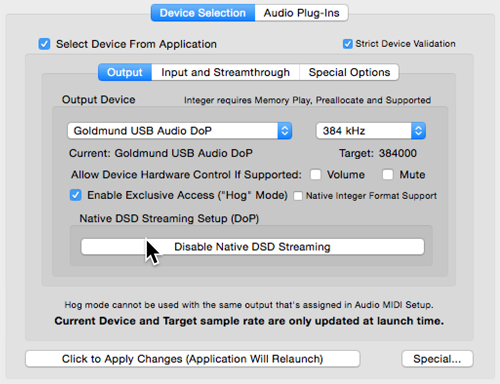
Obviously it can't be a Krell-type power-doubling weight lifter—I actually don't own amp-eating speakers to chronicle such defeat—but hoping for that in this package is back to silliness. The proper thing to say is that it's got plenty of power for the types of normal speakers reasonable people would buy and match. It also eliminates the constant fret work over the endlessly shifty DAC scene. Being 384kHz compliant with DSD128, it's all set for quite the foreseeable future. At left, you see how the INT appears to your computer. And yes, you're soundly locked in. So what? You're also liberated from paying that scene any more heed or deflationary coin. Sure, purists will get hung up on the analog input's conversion to digital. They imagine that the PGA chip of Job's preamp would have been better. Then why didn't Goldmund steal it from there ready-made—easier for them—instead of bothering with a different circuit? Just because the analog input exhibits a fine veil compared to the digital sockets does not imply that a pot or chip-based resistor ladder wouldn't throw a far coarser veil over all the inputs. Often superior solutions aren't actually flawless. They just suffer fewer flaws than the lesser solutions they trump. In the end, how much better do you imagine the Goldmund Metis 7 will be, costing seven times as much but looking virtually identical inside, to warrant that one overlook the Job INT? Case closed. Award time. |
|
|
Quality of packaging: High. Very thick cardboard box with clam-shell hard foam ends. FedUp and Oops proof.
Fit'n'finish: Perfectly adequate but clearly not bling.
Website comments: Very basic.
Human interactions: Swiss style (slow) and strangely evasive about certain very fundamental tech details.
Key design points: Class AB, digital volume, A/D conversion of analog input.
Suggestions for improvements: Functionally, I could see a number of customers wishing for a pre-out to use with a subwoofer or headphone amp but this might require a buffer which likely wasn't within budget.
Final comments: Whopper value particularly given Swiss manufacture and luxury-house origins. Where's the hitch? I couldn't find it.
|
 |
|
 |
|
|

|
|