 |
|
|
After this detour into a silver cable, we returned to 102 SSC copper-based cables, the Tunami Terzo XX V2 balanced and the Tunami Terzo RR V2 RCA interconnects. We played with these in two ways. One was the unbalanced connection between DAC and passive preamp followed by the balanced connection from preamp to power amp (the nCore 1200 monos only accept XLR). The other was having both Oyaide interconnects between DAC and preamp. This way we could switch inputs whilst the connection between preamp and power amp remained constant via a pair of Grimm Audio Pro balanced interconnect. Before getting to aural capacities, a few words on the connectors. Oyaide’s RCA connector here is called Genesis. Oyaide paid extra attention to the plug’s clamping action by employing a two-part sleeve. The outer sleeve’s rotational action forces the chuck to grasp the RCA receptacle tightly. This operates very smoothly and requires hardly any force. A tight connection is easily established between thumb and forefinger. The contact pins are phosphor bronze plated with platinum and rhodium whilst the sleeve is brass with a chromate plating.
|
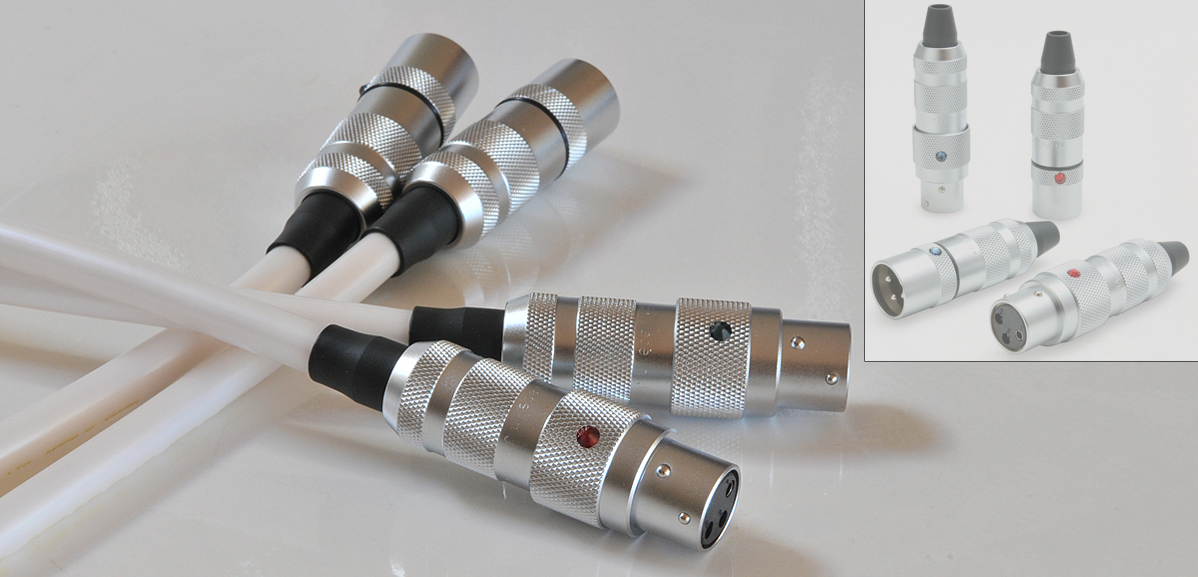 |
Similarly the Focus 1 plug on the balanced cables was an enhanced design. It sports a one-touch single action to disconnect the plug. By using a spring-loaded collar in combination with a ball bearing, operation is super smooth. Its spring loading offers additional tightening next to the lock provided by the receptacle. A really clever and certainly pro detail was the fact that pin 3 is longer. As the ground pin, its added length makes contact before the other two. This ensures a ground connection ahead of a power connection and eliminates pops when connection or disconnecting live cables on the fly. These contact pins again are phosphoric bronze with first a silver then rhodium plating. To attenuate rogue vibrations, the pins are molded into a PBT polybutylene terephthalate plastic that is enhanced with 30% glass. The hard chrome-plated brass sleeve is adorned with either a blue or red plastic ‘jewel’ for channel identification.
|
|
|
|
|
In our listening tests we noticed a difference in sound quality between RCA and XLR cables when used from source to preamp. We preferred the XLR version for its—pardon the pun—more balanced outcome. It seemed that some frequencies got extra attention when using the unbalanced connection. [In fairness, this also could have to do with how the DAC generates its RCA output. If the circuitry is dual differential, there will be some type of summing involved which could be inferior to the balanced output – Ed.]
To confirm this notion, we swapped the XLR-only Hypex amps for the all tube RCA-only Trafomatic Kaivalya monos. With only one pair each of RCA and XLR Tunami cables on hand, we needed an additional cable for an A/B. Luckily we have a pair of Neutrik XLR to RCA adaptors which could convert the Grimm Audio pro interconnect between preamp and power amps. Here we arrived at the same subjective conclusion that XLR trumped a single-ended connection. On the Oyaide cables as such, the fit and finish were great and the sound quality was on par.
Another non-102 SCC cable in the box was the AR-910. This came advertised as a cable that can be used as a digital or analogue interconnect. It too used the Focus 1 connector attached to 5N silver wire. These conductors were insulated with first a PE sheath followed by a PFA/carbon layer. Then come two shields, a carbon/copper foil and a silver-plated mesh visible through the clear polyurethane sheath. Being a hybrid digital/analog interconnect, the capacitance of the cable is important. In its analog form, capacitance is not too big an issue as long as it’s not excessive. For digital however, it is of crucial importance. Aalt-Jouk van den Hul explains capacitance in interconnects and its influences like this:
|
 |
"Regarding use as an analog audio interconnect: as long as the output impedance of your preamplifier is low enough (something like 300Ω or less), there will hardly be a sonic difference between various impedance types. With higher output impedances and large length cables on the other hand, there is risk that the cable’s parasitic capacitance-induced high frequency roll-off point will become audible. Worth knowing here is that, by design, the parasitic capacitance per meter decreases with cable impedance, 110Ω cables having the least. The remaining main parameters exerting influence on the sonic quality are the quality of the cable screen and the manufacturing quality of the conductors in general. The better the shielding, the cleaner the sound. The better (more careful) the conductor manufacturing, the lower the harshness in sound reproduction and the greater the spatial impression. Mind that 50, 75 or 110Ω impedance cables specifically have been optimized for high-frequency signal transmission. They are applicable but usually less suitable for use as a high-end audio interconnect. When used as a digital audio interconnect, the sonic differences between the various impedance cable types are large. The two prevailing digital audio signal transmission standards – S/PDIF (Sony/Philips Digital Interface) for consumer equipment and AES/EBU for professional use - each employ their own characteristic cable impedance of respectively 75 and 110Ω. Applying different impedance cabling here will yield signal reflections between the cable ends and as such will give rise to so-called jitter distortion."
|
 |
|
|

|
|

