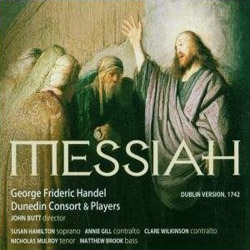
Album Title: Händel's Messiah (Dublin Version 1742)
Performer: John Butt / Dunedin Consort & Players
Label: Linn Records CKD 285 WMA 24/88kHz (also available as SACD, CD quality download and MP3)
Run time: 138 minutes
Recorded: Greyfriars Kirk, Edinburgh, UK: 1-4 May 2006
|
| Why record or for that matter review yet another Messiah? Everything there is to say has been written about masterful performances like Gardiner’s 1982 recording with the Monteverdi Choir and English Baroque Soloists; Sargent’s 1945 performance in Liverpool or more recently Sir Colin Davis’ stunning live recording with the LSO in 2006. John Butt, director and conductor of the Dunedin Consort, believes that despite the fierce competition, he can still shine a somewhat novel light on what must be one of if not the most often played religious composition in the world |
|
|
|
|
And to cut to the chase, he certainly does provide a somewhat provocative and certainly enlightening read of Händel’s global hit. Whether it makes a reference for the future is a lot less certain as far as I am concerned.
John Butt and the Dunedin Consort based their interpretation on the proven fact that Händel tailored the score of his Messiah to the forces available. This resulted in ten known separate versions of the composition, all revisions made by Händel himself. In Dublin 1742, Händel was faced with a much smaller orchestra and choir as well as a less talented crew than the staff he composed for in London. As a result Händel significantly simplified and rearranged the composition to accommodate a choir of around twelve voices, half of which doubled up as soloists. It's a set up the Dunedin Consort is ideally placed to reproduce. The orchestra also is simplified, calling only for strings, two trumpets, timpani and harpsichord. There are no oboes, serpents or organ as later versions may call for (although Händel had his own personal organ sent to Ireland for the first performance).
John Butt’s point id that there is no 'ultimate' version of the Messiah. Although the Dublin score may have been compromised by less than ideal resources on hand, it also shows what Händel probably considered to be the fundamental structure of the oratorio. In all cases, this is how the Messiah was heard for the first time ever before the London performances. Although it may take a little effort for our ears trained to enjoy slightly more consequent forces, the freshness and originality of the music are all preserved exactly like they were on that very first day.
One of the immediately obvious differences between this lightened version and more typical references is how easy each line can be followed. Each phrase, each musical line is individually sculpted to become a perfected miniature on its own.
Unfortunately I believe this added clarity at times also distracts from the emotional content of the music and the price to pay for such a reduced orchestra and chorus is unquestionably the lack of soaring dynamics and surges that make this composition what it is. The final Amen is a very good point in case. It should be a tidal wave of joy but here it never really takes off. The Hallelujah fares slightly better but compared to the Monteverdi Choir of 1982, it is hard to rejoice when listening to the Dunedins. Yes, diction is pristine and I was able to follow the text better than in any other version I have heard but everything here is delivered with the same flat perfection. More than once I wished the text had been butchered and passion flowed instead.
The soloists are a mixed bunch as well. Alto Clare Wilkinson completely enthralled me in "he was despised", clearly being the best performance of this emotionally loaded aria (proof that at times, passion surfaced but alas,all too rarely). Tenor Nicholas Mulroy also performed very well particularly in his delivery of the duet "O Death, where is thy sting". No such thing can be said about the two basses who lack power, projection, depth and strength. In "The trumpet shall sound", one should hear thunder in the singer’s voice. Most of the bass arias are unfortunately delivered with a flatness that does no justice. If you want to know what those arias should sound like, check Robert Hale with Gardiner or Alastair Miles with Colin Davis (2006). They are the type of powerful delivery I am talking about which is missing in the Dunedin’s reading.
Yet there is plenty to love in this performance. The chorus airs not asking for power and dynamic prowess are superb, delicate and finely articulated. The orchestra is first rate throughout and truly the redeeming element of the show.
I think John Butt’s objective to recreate the first Dublin performance is fully reached with the enlightening perspective a lighter crew provides but also carries with all the limitations Händel himself had to face and live with but which we don’t really have to.
In the end I find this recording a great testimony for people interested in the history of music and how the Messiah evolved over the years but I’d have a hard time recommending it as one of the references anyone with an interest in Händel should hear when one could choose between Gardiner (1982) or Davis (2006) instead to just name two of my favorites.
|